The skillet that raised $1.6 million to bring back 1900s american cast iron

Official homepage: https://fieldcompany.com
Cookware stores usually look forward. Field Company spent years looking backward — into flea markets, estate sales, and the bottom of grandmother's kitchen cabinets. The brand was founded by brothers Stephen and Chris Muscarella around a single frustration: the vintage Wagner and Griswold skillets they loved to cook on were lighter, smoother, and better balanced than anything sold new, and nobody made them anymore. Their answer became one of Kickstarter's most beloved hardware campaigns — a $30,000 goal that closed above $1.6 million — and a Shopify storefront that now anchors the premium end of American cast iron. I went through the store as someone who owns a Lodge, respects it, and wonders what twice the money buys. Here is what each dimension revealed.
Reverse-Engineering a Grandmother's Skillet in a Krakow Lab
The origin story is methodical in a way startup myths rarely are. The brothers began by stripping down dozens of vintage pans to understand what made them different: thinner walls, smoother surfaces, and geometry tuned for a wood-burning stove era. They flew to Krakow to consult a metallurgist and learned the honest truth — the original techniques were possible but wildly expensive, and exact replicas would cost a fortune at small volumes. So they reverse-engineered the outcome instead. A foundry outside Chicago agreed to pour their designs, scrap iron gets melted back into every batch so the pans run 75 to 90 percent recycled, and the casting method deliberately copies the vintage playbook: green sand molds, exactly like Griswold and Wagner used. The result they reached for — a smooth-surfaced pan that still holds seasoning, something not achieved since stone-grinding was abandoned in the early 1900s — became the company's founding claim, validated years later when Forbes and Food & Wine both named their skillet among the best in 2025.
From Wisconsin Pour to Indiana Machine Shop
What separates Field from boutique cast iron competitors is that the entire production chain is domestic and documented. Iron is poured in Wisconsin using the green sand process, then shipped to Indiana, where each pan is hand-finished to remove casting burrs and CNC-machined on the cooking surface — the step that creates the signature smoothness and removes the excess weight. After machining, every pan goes through a multi-stage seasoning line: three coats of organic grapeseed oil, polymerized so the skillet arrives genuinely ready to cook. Zero chemical coatings, PFOA- and PTFE-free by construction rather than by reformulation. On the storefront, this process is narrated with unusual pride — the company names its foundry partners' region, shows the machine shop, and treats manufacturing transparency as part of the product. For buyers tired of "designed in USA" asterisks, the directness lands.
The One-Pound Weight Difference You Feel Daily
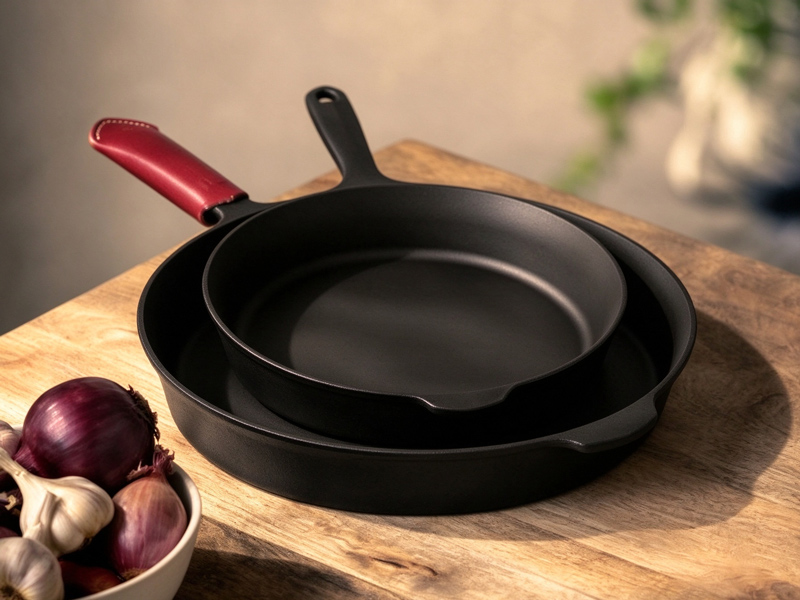
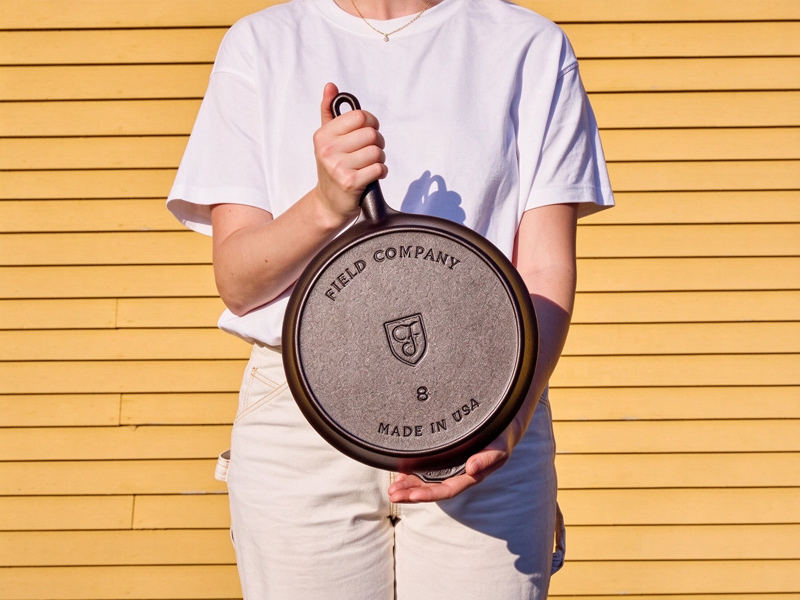
The flagship claim — lighter and smoother — translates into something concrete at the stove. A No.8 Field skillet weighs about 4.3 pounds against roughly 5.35 for the Lodge of the same vintage-style 10.25-inch size, with thinner sidewalls, a longer handle, and an 8.75-inch machined cooking surface that eggs actually respect. That pound matters less on a burner and more at the end of a dinner party, when a full pan needs one hand, a tilt, and a wrist that isn't twenty anymore. The trade-offs are honest ones: less thermal mass means marginally less heat retention for massive sears, and the smooth surface, as the founders learned from their biological-chemist collaborator, holds seasoning differently than pebbly modern iron — it rewards patience and punishes neglect. Field's own guidance and community reviews converge on the same advice: the pan cooks brilliantly once its patina matures, which takes weeks, not minutes.
Vintage Numbers, Dutch Ovens, and Live-Fire Skillets
The catalog wears its archival obsession in its naming — skillets numbered No.4 through No.12, a legacy sizing convention borrowed from the vintage world, which the store explains in a friendly size guide. Around the skillets, the line has grown into a genuine system: lidded Dutch ovens, flat griddles, a massive double-handled No.16 built for live-fire cooking, lids that cross-fit between pieces, leather handle covers, and small collaborations like cherry wood spoons carved in Vermont by a master spoon maker. The sets lean into occasion logic — a Cast Iron Classics pair, a Hosting Set spanning five skillet sizes, a nine-piece collection pushing past $1,100 for the completist. The breadth occasionally risks collector-ware drift, but the core promise stays narrow: every piece is the same iron, the same machining, the same seasoning standard.
The Care Kit Economy Built Around One Pan
Field monetizes the relationship after the sale with unusual thoroughness. The accessory shelf covers nearly every friction point of cast iron ownership: a natural fiber brush for gentle cleaning, a chain mail scrubber for stuck-on residue, proprietary seasoning oil, leather handle covers, and a care kit bundling all of it. Starter sets pair the No.8 with the full cleaning kit, quietly teaching new owners that cast iron is a maintenance hobby, not a passive pan. The education layer — how to wash, how to dry, how to re-season, why the first month is the hardest — is woven through product pages and the company's guides with the patience of people who expect these pans to outlive their buyers. This is the rare store where the upsell feels like stewardship rather than extraction.
Paying Five Times Lodge Money for Smoothness
The value question hangs over every Field purchase. Skillets run from the mid-100stothemid−100s to the mid-200s — the No.10 sits at $215 — which is five to seven times a Lodge of comparable size, for iron that performs the same fundamental job. What the premium buys is tangible but specific: the machining, the lighter geometry, the grapeseed pre-seasoning, the 45-day home trial that lets you cook on it before deciding, the lifetime warranty, free shipping over $150, and the documented American supply chain. What it does not buy is more searing power or durability — Lodge will outlive its owner just as certainly. Field's honest competitor comparison pages acknowledge as much, positioning the brand as the choice for the cook who reaches for cast iron daily and wants that daily reach to feel good, not just work.
Heirloom Iron for People Who Hate Heavy Pans
Field Company earns its premium for a buyer Lodge never tried to serve: the everyday cast iron cook with a small kitchen, a modest wrist, and an eye for objects that improve with age. For that person, the No.8 is arguably the finest mass-producible cast iron skillet made in America — smooth where it should be, light where it counts, honest about its origins, and backed by a company that answers its own warranty phone. It loses the budget buyer, the maximal-thermal-mass searing purist, and anyone who wants perfection on day one without earning the patina. This is a store built on a single act of reverse engineering, scaled into a full American supply chain, and sold with unusual candor about what cast iron asks of you. The vintage pans it set out to resurrect are still cheaper at estate sales — assuming you can find them, and assuming a century of someone else's care. Field sells the same ending, new, with the care instructions included.