De buyer, 196 years in: the french steel pan built for your grandchildren
Official homepage: https://www.debuyer-usa.com
Cookware stores usually have a founding myth. de Buyer has a founding century. The French manufacturer has operated the same forge in Le Val-d'Ajol, in the Vosges mountains, since 1830 — through six generations of family ownership, two world wars, and every cookware fashion cycle from copper to ceramic to the current steel revival. It makes roughly three thousand products across carbon steel, stainless clad, copper, and nonstick, sells heavily to professional kitchens and culinary schools, and carries the French government's EPV label — Entreprise du Patrimoine Vivant, the state-recognized mark of living industrial heritage. Its American storefront runs on Shopify at debuyer-usa.com. I went through the store as a home cook curious why chefs keep calling this the default pan. Here is what each dimension revealed.
One Family Forge, Six Generations of Steel
The heritage is not marketing varnish. The company was founded in 1830 as a small smithy working metals mined locally, later purchased by Alfred de Buyer, and remains family-controlled today under the sixth generation. What separates de Buyer from heritage brands that coast on the past is that the past is the production line: the factory still stamps, welds, and finishes carbon steel in the Vosges, and the EPV certification requires the government to verify that the traditional skills survive intact. The professional adoption is equally real — Ferrandi, one of France's most prestigious culinary schools, teaches on Mineral B steel, and bistros across Europe treat these pans as consumable infrastructure. On the US storefront, the story is told through an "About" page and collection copy that leans on dates more than drama, which feels right for a brand whose credibility comes from outlasting trends rather than inventing them.
Decoding Mineral B, Pro, Blue, and Copper Lines
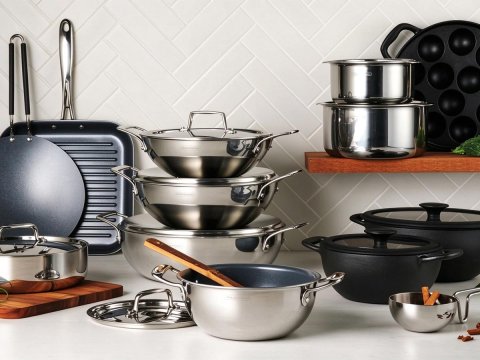
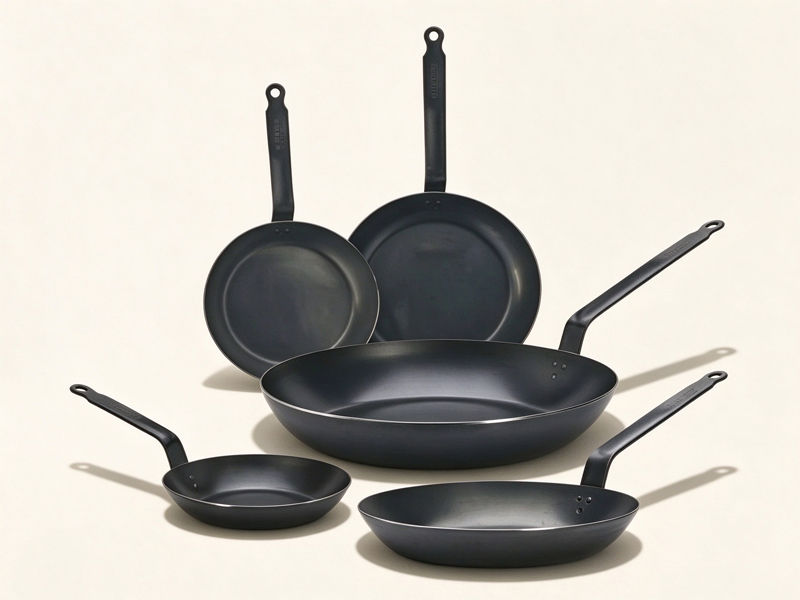
The catalog's breadth is the store's first navigational challenge, because de Buyer builds in tiers. Mineral B is the iconic line: 99% iron, 1% carbon, a beeswax anti-rust finish, and an epoxy-coated steel French handle angled upward so it clears neighboring pans. Mineral B Pro upgrades to cast stainless handles, adds a hanging hole, and — critically — becomes fully oven-safe. Blue Carbon Steel covers specialty shapes: crepe pans, woks, baking sheets. Affinity and Alchimy carry the stainless-clad business, while Prima Matera and Inocuivre handle copper, with Prima Matera solving the rare problem of induction-compatible copper. The US store surfaces this reasonably well through collection pages and comparison copy, though the naming assumes more familiarity than a first-time steel buyer has. The product pages themselves are admirably specific — thicknesses in millimeters, cooking-surface diameters, weights in pounds — the spec density of a supplier catalog dressed in Shopify clothing.
Beeswax, Patina, and the Seasoning Education Business
What de Buyer actually sells is a relationship with a material. Every carbon steel pan arrives coated in food-safe beeswax that must be washed off, then seasoned — heated with oil until the surface polymerizes into the dark, slick patina that becomes more nonstick with every meal. The store treats this onboarding as a feature, with seasoning tutorials, FAQ trees, and care guidance embedded on product pages. The pitch is honest about the work: hand wash, dry immediately, re-oil lightly, never the dishwasher. Owners who commit describe the transformation as addictive — one storefront reviewer noted the pan went properly nonstick after a final oven seasoning with grapeseed oil, the handle staying cool through high-heat cooking. The counterweight is equally documented: skip the drying step and orange rust blooms within hours, and neglected pans require stripping and re-seasoning. This is cookware with a maintenance contract, and the store never hides it.
The Epoxy Handle Fine Print Nobody Reads First
Here sits the dimension every buyer should read twice. The standard Mineral B line's epoxy-coated handle caps oven use at brief flashes — up to roughly 400°F for ten minutes — because the coating degrades beyond that. Only the Pro line's cast stainless handles tolerate full oven service. The Blue Carbon Steel line splits the difference by item, with the Access fry pan and wok fully oven-safe while the crepe pan and La Lyonnaise are flash-use only. The US store publishes all of this, but it lives in FAQ blocks and care tabs rather than the buy box, and forum threads show years of confusion from owners who discovered the limit the hard way. None of it is deception — it is engineering transparency with suboptimal placement. Add hand-wash-only discipline and the induction-compatibility caveat for certain copper pieces, and the real de Buyer buyer is someone who reads spec pages for pleasure.
Accessible Pro Pricing Through a Stateside Storefront
The surprise of the US store is the price. Carbon steel Mineral B skillets sit between roughly $60 and $120, the Pro value sets appear with genuine sale pricing — a two-pan Pro bundle listed at $196 against a $245 regular price — and even the copper lines undercut comparable Mauviel by meaningful margins. The lifetime guarantee badge on Pro sets, the two-year warranty standard in EU retail, free-shipping thresholds, and periodic sitewide promotions make this one of the cheapest ways to buy true professional-grade French steel. The trade-offs are the ones inherent to import retail: occasional stock gaps, shipping weight on 6.4-pound skillets, and the fact that the American storefront's pricing sometimes trails Amazon or restaurant-supply discounters by enough to matter. For buyers who want the boutique experience and the tutorials, the direct store earns the small premium.
Buy Once, Season Forever, Pass It Down Twice
de Buyer earns its recommendation for a cook no startup brand has tried to serve: the patient pragmatist who wants one pan to outlive their mortgage and doesn't mind a learning curve measured in weeks. For that person, a Mineral B Pro skillet is arguably the best value in all of cookware — pro-kitchen performance, French factory provenance, a seasoning patina that improves for decades, and a price under what a disposable ceramic set costs twice over. It loses the buyer who wants zero maintenance, the oven-braising specialist who grabs the wrong line's handle, and the shopper who measures value in unboxings rather than decades. This is a store built on the oldest promise in the category, kept for 196 years in the same valley: buy once, learn its care, and cook on it longer than most companies survive. Almost nothing being advertised louder this year will still be in your kitchen in thirty years. This will.