The design school assignment that ended up in the v&a
Official homepage: https://www.areaware.com
Blockitecture began as homework. It ended up in a museum collection.
In 2013, Rochester Institute of Technology industrial design student James Paulius entered a class project into a competition run with a New York design studio called Areaware — and won. The assignment became a product, the product became a series, and a decade later one of its sets sits in the Victoria and Albert Museum's collection of construction toys. This review examines the unusual school-to-shelf pipeline behind Blockitecture, the New York studio that pays independent designers royalties, and what separates a design-store block from a toy-store block.
A Homework Brief from a New York Studio
The story starts with an educational experiment. RIT's Metaproject course pairs students with a real company — in this case Areaware — and asks them to design products the company could actually manufacture. The 2013 edition, Metaproject03, took building blocks as its brief, and a Chicago-born student named James Paulius submitted a set of hexagonal wooden pieces inspired by modern architecture.
Paulius won first place, and unlike most student competitions, this one had a manufacturing clause attached: Areaware produced the winning design and put it into commercial production. The set launched as Blockitecture Habitat in 2014, and the V&A later documented the whole arc — from student brief to mass-produced object — when it acquired Blockitecture Big City for its collection. Few toy lines can claim their origin story is preserved in a museum's object records.
Habitat 67 as the First Building Block
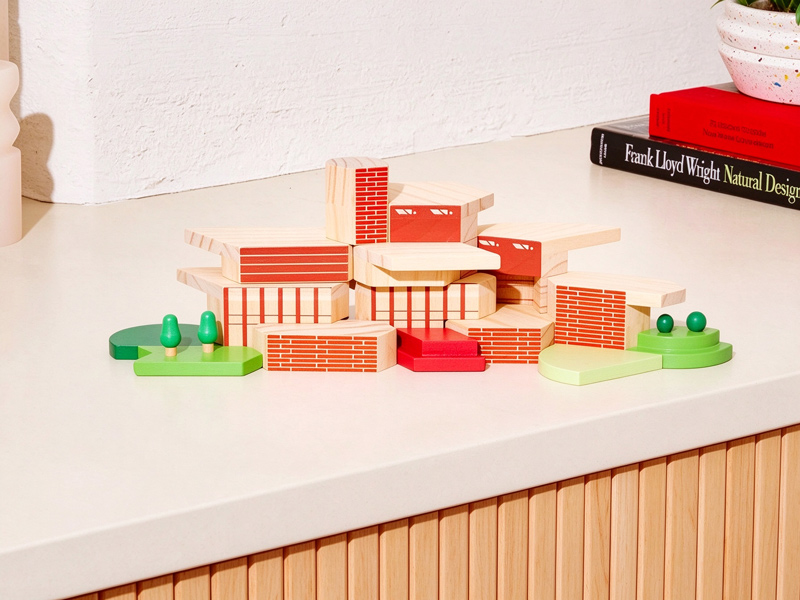
The design's reference point is one of architecture's most famous experiments. Habitat 67, Moshe Safdie's pavilion for the 1967 Montreal World's Fair, stacked prefabricated concrete housing modules into a sculptural hillside of homes — and Paulius translated its visual language into small wooden hexagons. The first set's name makes the lineage explicit.
That inspiration gives the blocks a different personality from unit-block classics. Instead of right angles and gravity-fed stacking, Blockitecture pieces nest together through hexagonal geometry and hold structures together through counterbalance and cantilever — the same structural logic that made Habitat 67 visually thrilling. Children building with them are, almost accidentally, rehearsing principles of balance and load that ordinary rectangular blocks never demand.
Hexagons, Cantilevers, and Balance Over Brute Force
The play physics reward a specific temperament. Rectangular unit blocks forgive almost everything; a poorly stacked tower simply falls and gets rebuilt the same way. Blockitecture structures lean, cantilever, and counterweight — the pieces invite overhangs and suspended forms that would collapse in conventional systems, which means the builder is constantly reasoning about balance rather than just piling.
This is open-ended play with a physics curriculum inside it, and the designer has said as much in interviews: the goal was to foster an understanding of geometry and physics while making the point that the built environment is something anyone can create. Whether a six-year-old absorbs the urban-planning subtext is debatable; that they engage with cantilevering intuitively is not.
New Zealand Pine, Water-Based Paint, Museum Grade
Materials follow the design-store register rather than the toy-store one. The blocks are cut from New Zealand pine and finished with water-based paint — the same material language as premium wooden toy lines, but with tighter tolerances and a matte, architectural palette. The Habitat set's ten towers feel closer to scale-model building components than to nursery blocks.
The finish is the give-away of the intended audience: these are objects meant to live on a shelf or a studio desk as readily as on a playroom floor, and the packaging, photography, and museum-store placement all reinforce that dual identity. Buyers seeking bright primary colors and character themes will find the restraint either sophisticated or joyless depending on taste.
The Studio That Pays Designers Royalties
Areaware itself deserves explanation, because its business model shapes the product. The New York studio, founded in 2005 by designers Noel Wiggins and Spencer Staley, specializes in working with independent designers: the studio oversees creative direction, development, sourcing, marketing, sales, and distribution, while the designer works on a royalty basis. Blockitecture is one line within a catalog spanning home objects, lighting, and play — a catalog built from dozens of such collaborations.
For buyers, the model means the product carries a named author's sensibility rather than a brand committee's. For the category, it explains why Blockitecture kept evolving across years — the designer remained engaged as the line extended into Deco, Factory, Tower, Big City, and a New York City series with 74-piece Big Apple, 14-piece Skyscraper, and 15-piece Greenway sets inspired by the city's architecture and public spaces.
Design Shops, Museum Stores, and the Big Apple
Distribution tells the positioning story. Blockitecture sells through high-end design shops, museum stores, and department retailers like John Lewis — the V&A notes the product's commercial success across exactly that spectrum, from design boutiques to high-street shelves. Areaware's own Shopify store anchors the direct channel, carrying the full Blockitecture range plus the studio's wider catalog.
For shoppers, this placement is both promise and price signal: the sets cost more than supermarket blocks and less than collector-grade wooden toys, and the purchase buys design-world credibility alongside the play value. International availability through Areaware's direct store covers regions the museum shops do not.
Small Production Runs and the Collector Question
Areaware's archive reveals an interesting economic fact: individual Blockitecture editions are produced in the low thousands. The Habitat set — the line's bestseller — shows a cumulative production around 35,000 units, while later editions like Big City and the Towers number in the low-to-mid thousands. These are design-object volumes, not toy-aisle volumes, and they shape everything about the line's economics.
Small runs keep the design fresh and the quality controlled, but they also mean availability varies by edition, and popular configurations can sell through between restocks. Collectors should know that the line is a living catalog rather than a permanent archive — sets rotate, and the secondary market for retired editions already exists.
One Line in a Catalog of Design Objects
It is worth being honest about what Blockitecture is within Areaware's world: one product family among dozens, sharing a storefront with sculptural bottle openers, architectural candles, and furniture-grade objects. The studio's expertise is design direction and distribution, not deep play-category specialization — which shows in a catalog that is beautifully curated but not encyclopedic.
The practical consequence for the buyer: this is where you buy the line when you want the design-object treatment, not where you go for advice on which set suits a four-year-old versus a nine-year-old. The retailer's editorial sensibility favors the adult purchaser, and parents wanting developmental guidance will find the museum-shop framing more elegant than informative.
Who Buys Blocks from a Design Store
The Blockitecture customer spans two households that rarely share a cart: the design-literate parent or godparent buying a gift that signals taste, and the adult desk-object collector who builds cantilevered towers during phone calls. Educators in design-minded schools form a third niche, using the sets to make geometry tangible.
The verdict a decade in: a student assignment that became a museum piece remains one of the most intellectually satisfying block systems money can buy. It will never outsell the primary-colored bin of unit blocks — and from Areaware's production runs, it was never meant to. For the right shelf, it is exactly the right object.