The billion-dollar pan: how hexclad's hexagons built a cookware empire so fast
Official homepage: https://hexclad.com
Cookware stores usually grow slowly. HexClad grew like a startup because it is one. The Los Angeles brand — founded in 2016, launched in 2017 — turned a laser-etched hexagon pattern into a business that cleared $550 million in annual revenue, attracted a $100 million investment from Gordon Ramsay's Studio Ramsay Global at a reported billion-dollar valuation, and became the first cookware brand ever to buy a Super Bowl ad. All of that for a pan category — hybrid stainless-nonstick — that barely existed a decade ago. I went through the Shopify store as a skeptical home cook who has seen the ads and wants to know what's underneath the hexagons. Here is what each dimension revealed.
From a Dead Juicer Business to a Trade Show Eureka
The origin story starts with a failure. Before HexClad, Daniel Winer was losing money on a cold-press juicer, watching the juicing boom migrate from home kitchens to retail chains until he shut the business down. The pivot came at an Asian trade show, where he met a Korean entrepreneur who had invented a nonstick pan with a laser-etched hexagonal surface — a hybrid that promised stainless searing power with nonstick cleanup, metal-utensil durability, dishwasher safety, and heat tolerance up to 900 degrees. Winer, who knew cookware from a prior job, reportedly looked at the prototype and thought the same three words three times: solved, solved, solved. Co-founder Cole Mecray joined, investors laughed at the idea of direct-to-consumer pots and pans, and Winer turned those rejection meetings into Facebook ad copy. The company now operates under the parent entity One Source to Market, LLC, distributes across the US, Canada, UK, EU, Australia, Mexico, and Japan, and sells through its own storefront, Amazon, and Costco aisles.
What the Hexagon Pattern Actually Does to Food
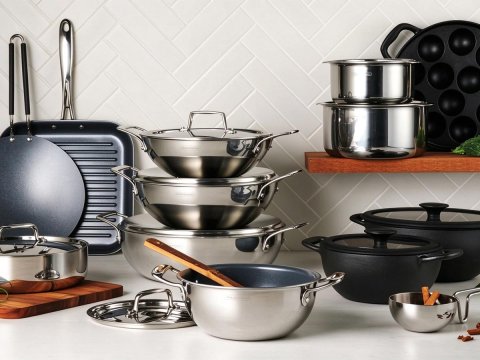
The technology is real and worth explaining precisely. HexClad pans are tri-ply — aluminum core between stainless layers — with a patented laser-etched hexagonal lattice on the cooking surface. The raised stainless hexagons handle the searing and the metal spatulas; the recessed channels between them carry the PFOA-free nonstick coating that releases eggs and cleans easily. In practice the pattern works as advertised: heat distribution is impressively even, a steak develops a proper crust, and an egg slides after a light grease. The honest nuance lives in the chemistry. The recessed coating is PTFE-based, not ceramic — inert and safe at normal temperatures, but a different material family from the PFAS-free ceramic coatings dominating the marketing conversation right now. That distinction matters for durability expectations: PTFE hybrid coatings wear gradually at the hex edges and at high heat, and owners who treat the pan like pure nonstick — no oil, high flame — report sticking within the first year, a complaint echoed by independent testers who found eggs cling unless the pan is greased.
A Celebrity Co-Owner Rather Than a Spokesman
The marketing machine is the industry's most instructive case study in equity partnerships. Gordon Ramsay didn't license his name — he bought in. After discovering the pans through social media around 2020 and dubbing them "the Rolls Royce of pans," he became an equity partner and lead ambassador in 2021, actively involved in product development, then doubled down in July 2024 when Studio Ramsay Global invested $100 million at a valuation near $1 billion. The creative output escalated accordingly: a Super Bowl spot in February 2025 called "Unidentified Frying Object," co-starring Pete Davidson in an Area 51 test kitchen, making HexClad the first cookware brand in the game's history. The storefront absorbs all of it — Ramsay's face and quotes anchor the homepage, recipes and cooking-show integrations feed the content layer, and the UK arm recently added Clare Smyth, the first British woman to hold three Michelin stars, as a partner. Whether you find the halo convincing or exhausting, the structure behind it is genuinely more committed than a rented endorsement.
The Settlement That Rewrote the Marketing Language
Here is the dimension the ads never mention. In 2023, a class action lawsuit was filed against HexClad's parent company alleging that certain marketing claims about product materials were misleading. The company agreed to a $2.5 million settlement and, as part of the deal, updated its marketing language regarding product materials. No admission of wrongdoing, no recall, no safety finding — but a documented, public correction of how the pans were described to buyers. The episode matters less for what it proved than for what it teaches about the store's claims engine: the same marketing velocity that built the empire also outran its own accuracy, and the settlement is the receipt. Shoppers reading "hybrid technology" copy today are reading post-settlement language, which is arguably more trustworthy than what came before — and the store says nothing about the upgrade.
Warping Reports, Hot Handles, and Warranty Denials
The long-term owner record is more mixed than the billion-dollar narrative suggests. Positive reviews dominate — durability, searing, looks — but the complaint cluster is consistent across aggregated reviews: the nonstick performance degrades faster than the price implies, some pans warp on induction burners, handles run hot, and warranty service draws real anger. Owners report lifetime-warranty claims denied over "dishwasher use" despite the pans being advertised as dishwasher-safe, and Made In's own comparison content notes customer-service frustration and refund difficulty. Independent testing has been kinder — Consumer Reports scored a HexClad pan "Very Good," CNN Underscored praised its even heating, Good Housekeeping named it the best hybrid — but the professional-kitchen survey data that circulates is less flattering, with chefs reporting coating failure at the hex edges and induction warping after eighteen months of service use. The fair synthesis: exceptional performance inside its design envelope, unexceptional longevity outside it.
Lifetime Warranty Math at Costco Prices
The store's pricing runs $99 for entry pieces to $998 for full sets, with mid-range sets in the 400–400–700 band that the brand defends as per-decade math under a lifetime warranty. The fine print deserves attention. The warranty covers defects, not wear — and on a hybrid coating, wear is the failure mode most buyers will eventually meet. The Costco channel changes the calculus again: warehouse pricing undercuts the direct storefront, bundles appear and disappear seasonally, and the store's perpetual sale cadence means MSRP functions mostly as an anchor. International storefronts localize pricing for the UK, EU, Australia, and Japan, but origin labeling — designed in Los Angeles, manufactured in China and Korea — sits quietly on spec pages rather than in headlines. For a buyer who reads warranty terms before checking out, the value case is real but narrower than the marketing implies.
An Empire Built on a Pattern, Priced Like a Promise
HexClad earns its premium for the buyer who sears often, cleans in a dishwasher, uses metal tools without guilt, and wants one pan to behave like three. For that cook, the hybrid technology is the rare case where the infomercial logic survives contact with the stove, and the Ramsay-backed engineering pipeline keeps improving the line. It overpromises for the budget buyer, the ceramic-or-bust shopper who wants PTFE out of the kitchen entirely, and the warranty-first buyer who will someday test whether "lifetime" means their lifetime or the coating's. This is a store built on a genuinely clever surface pattern, scaled by one of the most sophisticated celebrity-equity machines in consumer products, and tempered by a public settlement it would rather you forget. The pans are very good. The empire around them is better at selling than the pans will ever need to be.