Our place cookware review: we tested the always pan beyond the instagram hype
Official homepage: https://fromourplace.com
Cookware stores usually sell you a pan. Our Place sells you a dinner table you haven't built yet. The Los Angeles brand — launched in September 2019 by Shiza Shahid, the former co-founder and CEO of the Malala Fund, alongside her husband Amir Tehrani and their friend Zach Rosner — built its entire identity around a single pastel pan that promised to replace eight traditional pieces of cookware. It sold out ten times, drew a waitlist in the tens of thousands, became an Oprah favorite, and turned a direct-to-consumer cookware launch into a cultural moment. I went through the Shopify store as someone who has scrolled past those pans a thousand times and wants to know what remains after the feed refreshes. Here is what each dimension revealed.
From the Malala Fund to a Thirty-Thousand-Person Waitlist
The founder story is unlike anything else in the category. Shahid spent her twenties building the Malala Fund with Nobel laureate Malala Yousafzai, then walked away from nonprofit leadership in 2017 to prove that a mission-driven company could move faster than a foundation. The origin of Our Place is autobiographical: a Pakistani immigrant walking into an American kitchenware store, asking what a beginner needs, and being handed a sixteen-piece set. The insight was demographic and emotional at once — first-generation cooks, small kitchens, multiethnic households, and the belief that one well-designed pan could lower the barrier to cooking at home. Tehrani brought his family's kitchenware supply background, Rosner brought startup operating experience from MeUndies and Everlane, and Shahid brought storytelling gravity that most cookware founders can only rent. On roughly $7.5 million in outside funding, the brand was reportedly profitable within months and did about $20 million in its first full year — an almost unheard of capital efficiency for a physical-product company.
The Ten-in-One Pan and What It Really Replaces
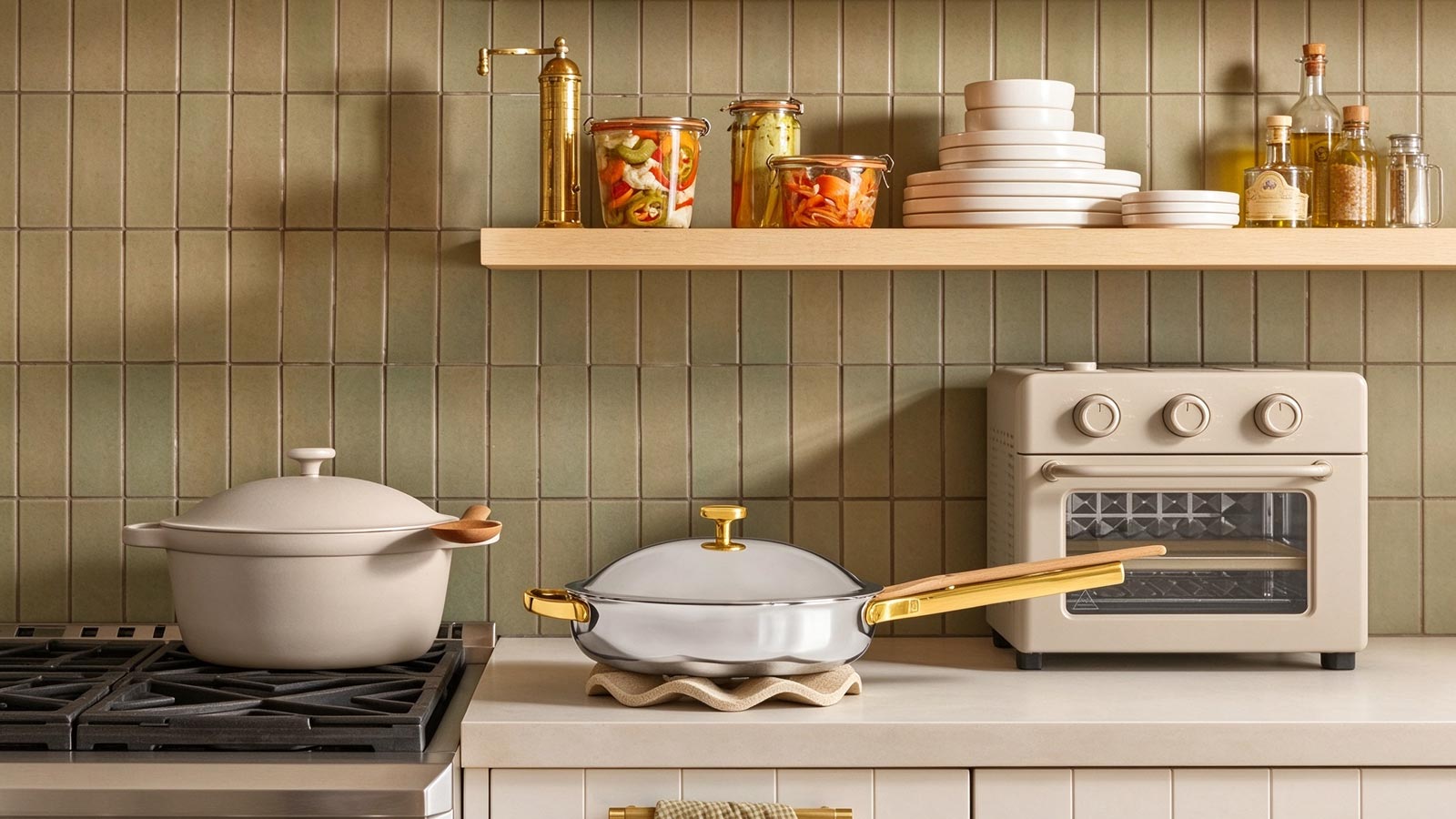
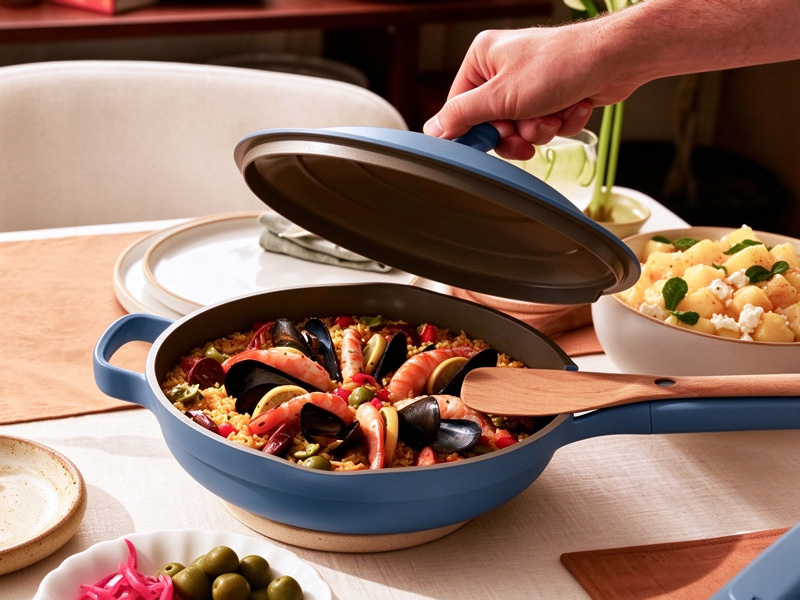
The Always Pan's claim is a single piece of cookware that braises, sears, steams, strains, sautés, boils, fries, roasts, bakes, and serves — with "enchantment" jokingly listed as the eleventh function. The engineering behind the claim is thoughtful. The body is recycled aluminum around 2.6 millimeters thick, coated in the brand's proprietary Thermakind ceramic nonstick that is free of PFAS, PTFE, and PFOA, and shaped deeper than a skillet but wider than a saucepan so it can hold a braise or a whole chicken. The accessories do real work: a nesting beechwood steamer basket, a spatula that rests on the handle, and a modular lid that strains pasta without a colander. The honest limits are equally real. The ceramic coating demands low-to-medium heat and hand washing, oven use is capped well below what stainless or cast iron tolerates, and a pan this versatile is not a pan this specialized — cooks who sear hard, bake high, or wok-fry at flame level will outgrow it. The Always Pan 2.0 refined the coating and construction, and the Titanium Always Pan Pro introduced the brand's patented NoCo coating-free nonstick surface, hard enough for metal tools and dishwashers, which earned a spot on Time's Best Inventions of 2024.
From One Pan to a Full Kitchen Platform
What started as a single hero product has become a system. The Perfect Pot extended the same logic to the stovetop's other half — a five-plus-liter vessel pitched as replacing up to ten pieces, from stockpot to Dutch oven. Mini versions of both followed, then enameled cast iron positioned as heirloom quality, then tableware, drinkware, and serveware designed to keep the aesthetic coherent from stove to table. Most recently the brand crossed into appliances with the Wonder Oven, a six-in-one air fryer and toaster oven with steam infusion, and the Dream Cooker, a multicooker that pressure cooks, slow cooks, and sautés. The platform strategy is clear — own the entire cooking ritual, not just the pan — and it mirrors what happened to category leaders like Instant Pot and Vitamix. The risk is dilution: every new category stretches the design team's attention, and the appliance lines compete in markets with entrenched giants and thinner margins than pastel pans.
Oprah, Selena, and the Multicultural Marketing Playbook
The marketing engine is the brand's most studied asset. The Always Pan's Instagram-native aesthetic — muted pastels, soft light, steam rising in slow motion — made it the most photographed pan of its era, with roughly 665,000 followers watching. Oprah's Favorite Things endorsement in 2020 was the inflection point, followed by a limited-edition Selena Gomez collaboration and organic devotion from names like Cameron Diaz and David Beckham. The deeper play is cultural. Collections honor Nochebuena, Lunar New Year, Nowruz, Ramadan, and Shabbat; each collection pairs with a charity partnership, and the company claims over two million meals donated to food charities. The brand frames cookware as a vehicle for belonging — "kitchenware for the modern, multiethnic, global kitchen" — and backs the framing with a team composed mostly of women and immigrants. Skeptics can call it values-washing; the consistency of execution across products, philanthropy, and retail experiences makes the charge harder to land than with most mission-brands.
Coating Lifespan, Oven Limits, and the Aldi Dupe
The honest testing record looks much like the rest of the ceramic category. Out of the box, the nonstick is superb — eggs release, cleanup is a wipe, and the pan is genuinely beautiful on a stovetop. Over a year or two of regular use, the Thermakind coating wears in the familiar sol-gel pattern: food begins to cling, the surface dulls, and the pan that looked eternal starts looking like a consumable. The original line's oven ceiling and hand-wash guidance narrow the use cases further, though the titanium line directly answers both complaints. The dupe economy arrived quickly and bluntly: Aldi's Crofton Awesome Pan, a $34.99 imitation with the same silhouette, basket, and spatula, has been reviewed side by side with the original more than once, and the comparisons are closer than the price gap suggests. None of this makes Our Place dishonest — it makes it a ceramic nonstick brand in a category where physics, not marketing, sets the lifespan.
DTC Pricing, a Venice Store, and Thirty-Day Trials
Pricing runs $95 to $195 for the core cookware, with the Always Pan at $145 and sets climbing higher — accessible premium, deliberately below Le Creuset and All-Clad territory. The store backs purchases with free shipping and a 30-day trial, one of the most generous policies in the category, and the direct model keeps margins healthy while funding the design pipeline. The physical retail experiment tells a more complicated story. The Venice flagship on Abbot Kinney thrives as a brand temple, but the West Hollywood Melrose location — opened with design fanfare in February 2023 — closed less than a year later, undisclosed reasons, quietly removed from the website. International expansion has fared better, with a UK launch through Liberty London and localized storefronts carrying the full range. For a brand whose entire identity is place and belonging, the mixed brick-and-mortar record is a small but real signal about where the economics actually live.
A Pan That Sells Belonging, Backed by Real Engineering
Our Place earns its following for a specific cook: the beginner-to-intermediate home chef in a small kitchen, cooking across cultural traditions, who wants one beautiful pan that does most things well and looks like an intention rather than an accident. For that buyer, the design details — the straining lid, the resting spatula, the steamer basket — are not gimmicks but genuine reductions in friction, and the mission layer adds meaning most competitors can't match. It underdelivers for the high-heat specialist, the buy-it-for-life traditionalist, and the bargain hunter who has seen the Aldi shelf. This is a store that understood before almost anyone that cookware is purchased with identity as much as with money, then engineered real products to justify the feeling. The pans will wear out on schedule. The brand, judging by the waitlists it keeps creating, already hasn't.