Misen's honest till, opened in 2015: five-ply shelves, pre-order patience, lifetime promises kept
Official homepage:https://misen.com
Cookware stores usually open with a pan. Misen opens with a pricing argument hung above the door: the category forces a bad choice between flimsy cheap tools and overpriced “premium” brands, and this shop refuses to sell either one. The claim predates the store — it was tested on a crowdfunding page in 2015, where a $65 chef’s knife pulled in over $356,000. I browsed with that campaign in memory and the usual distrust for any brand that promises “honest pricing” without showing the arithmetic. The arithmetic, as it turns out, is on display.
The Manifesto as a Store Fixture
Most mission statements are wallpaper. Here the founding complaint does real structural work: it decides what gets stocked (working tools, never gadgets), how things are priced (direct, mid-premium), and what the brand will not touch (no heritage theater, no celebrity cosign, no borrowed French glamour). The sentence on the door and the inventory on the shelves agree with each other — rarer than it should be.
Shelf Discipline
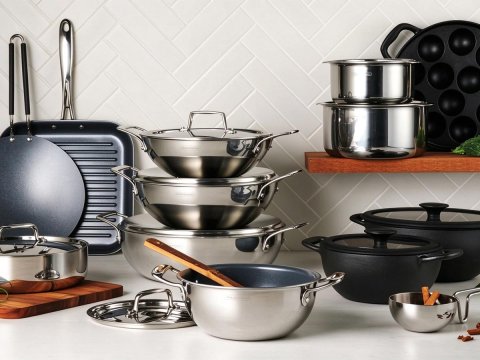
The catalog grew outward from that Kickstarter blade without ever sprawling. Knives led; five-ply stainless followed, 3.0 mm thick, steel and aluminum layered for even heating; then carbon steel, a Carbon Nonstick line, Dutch ovens, prep tools. Every extension is a material thesis rather than a trend chase, and a 12-inch stainless frying pan at $129 is priced and shelved like the working tool it is. The store never wanders into single-use gadgets or kitchen décor, because the founding argument was about tools.

The Price Mechanic: Waiting as a Discount
The most distinctive fixture is still the pre-order button. Years after the crowdfunding origin, new products invite customers to order ahead and save — currently fifteen percent with a code — in exchange for patience. No lightning deals, no countdown clocks, no manufactured scarcity. The factory’s schedule is disclosed, the wait is compensated, and urgency is never faked. For a shop born from a crowd-funded production run, this is not a promotion tactic; it is the operating model.
The Fine-Print Counter
Warranty terms sit in plain register: a limited lifetime warranty on materials and construction, with a shorter two-year promise reserved honestly for nonstick coatings — a distinction most rivals blur on purpose. Carbon-steel care instructions arrive before the complaint does, which reads as good teaching, good liability management, or both. Here the small print is not a trap. It is part of the merchandising.

Content as Stock
The store’s editorial pages perform the disclosures other brands outsource to skeptics: where the cookware is made (near Shanghai), how it is built (five-ply, 3.0 mm), and why prices land twenty-five to thirty-five percent below comparable premium pieces (the direct model strips retail markup). This is inventory that never sells out — a sales associate on permanent shift who never oversleeps and never oversells.
The Service Counter
The review trail reads like a service ledger: responses in minutes, replacements shipped without inquisitions, price adjustments honored after the fact, claims escalated to humans when automated triage misfires. The negative entries are instructive rather than damning — buyers who expected carbon steel to behave like coated nonstick, longtime customers still mourning a discontinued lifetime sharpening perk. What matters is the counter pattern: the shop answers, adjusts, and keeps receipts.