Militarybricks store review: what to know before you buy brick tank sets online

Official homepage: https://militarybricks.com
Building-block stores usually sell systems — the stud grid, the click, the compatibility promise. MilitaryBricks sells subject matter: tanks, planes, and ships from the wars that filled history textbooks, rendered in brick with a historical accuracy the copy treats as non-negotiable. I browsed with a grandfather who built model airplanes and a suspicion that military modeling had been waiting for its block-based era. Here is the counter, decision by decision.
Door Policy: Pick Your Battles
The homepage's banner reads like a recruitment poster for a different kind of army — pick your battles, then build them — the words printed across a brick wall in vintage military typography. Framing the store as a battlefield selection targets the collector rather than the child: the battles are historical, the sets are replicas, and the customer is choosing which theater of war to display on his shelf. The poster does the qualifying — anyone who flinches at the word battles was never the customer, and the customers who stay have already enlisted.
A Currency Earned by Rank
The loyalty program is dressed as a bank — BrickBucks, printed on illustrated bills signed by a Sergeant Brickowski, earned at ten percent on every purchase and spendable on the next. Designing the reward currency as physical military money is gamification aimed at the collector's inner child: the bucks feel like the toy soldiers' pay, the sergeant's signature gives the program a character, and the ten percent is wrapped in a narrative that makes the discount feel like a promotion rather than a coupon. The money is the retention engine, and the engine runs on pretend pay that buys real tanks.
Promotions With Patches
Beneath the currency sits a second ladder — Move Up the Ranks, where purchases earn promotion points and each promotion ships a collectable patch commemorating a historical military figure. Issuing patches as loyalty rewards is collection mechanics aimed at the completist: the patches are earned, not bought, each one names a real figure from military history, and the customer who collects patches collects sets the way a soldier collects ribbons. The ladder turns repeat purchasing into a service record, and service records are the one thing collectors cannot buy their way up.
Three Armories Under One Roof
The store carries three brick brands side by side — the Polish flag-bearer known for historical accuracy, the educational line with its smart-kids slogan, and the upstart with the question-mark logo — each filling a different price point and style. Curating multiple brands is assortment aimed at the customer who does not care which factory made the tank: the flagship brand provides the accuracy, the budget brand provides the volume, the challenger provides the novelty, and the store becomes the armory rather than a single manufacturer's outlet. The three brands argue the store's impartiality, and impartiality is the rarest virtue in retail.

The History Test as Quality Control
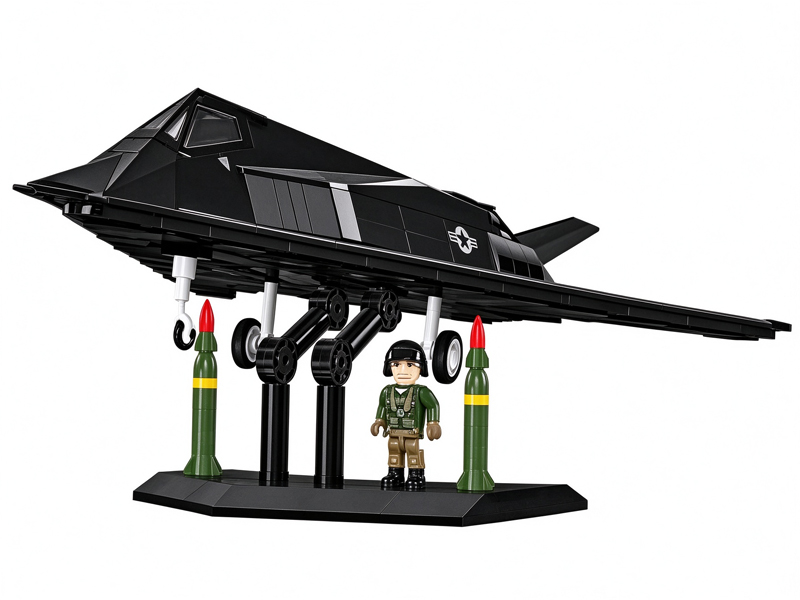
The copy's first promise is not about plastic but about the past — historically accurate, with shapes, proportions, and features that reflect the real vehicles — and the education section extends the claim: learn history while building, the sets described as hands-on gateways to the events that shaped the world. Anchoring the catalog to historical fidelity differentiates for the adult builder: the accuracy justifies the display, the history justifies the purchase to a skeptical spouse, and the store has converted a toy category into a museum category. The history is the quality seal, and the seal is earned in the details of the rivets.
The Click Heard Across Brands
The quality promise is rendered in a single satisfying word — clickability, the sound a brick makes when it locks, guaranteed to persist for years of use. Naming the sensation rather than the specification is sensory positioning aimed at anyone who has built with inferior bricks: the click is the entire quality argument compressed into one syllable, the onomatopoeia carries more information than a tolerance figure, and the store has staked its reputation on a sound. The click is the warranty you can hear, and the hearing requires no specification sheet.
The Container Clock
The new-release section explains the supply chain with unusual candor — new sets arrive the day after they are unloaded from the container, the copy promising notification the moment stock hits US soil. Publishing the logistics timeline is speed credibility aimed at the impatient collector: the day-after promise says the store's supply chain is shorter than the competitors', the container detail admits the global reality rather than hiding it, and the newsletter becomes the early-warning system for a community that wants to build first. The container is the calendar, and the calendar is the one collectors mark.