Koss store review: what to know before you buy classic stereo headphones online
Official homepage: https://koss.com
Headphone stores usually promise the future — the newest driver, the latest codec, the next form factor. Koss sells the past, and the past it sells is the category itself: the company invented the stereo headphone in 1958, and the homepage still honors that invention by selling its own history as a product line. I browsed with a suspicion that vintage branding is usually a costume, and a curiosity about what it looks like when the costume is actually the family business. Here is the counter, decision by decision.
Door Policy: The Invention as the Address
The storefront's founding fact is not a marketing claim but a historical record — the world's first stereo headphone, built in Milwaukee in 1958 — and the navigation carries a History tab beside the shopping categories. Leading with the invention rather than the product is provenance aimed on the customer who has heard of the Porta Pro but not the company: the first says the brand wrote the category's opening page, the history tab says the company kept the receipts, and the customer who buys a Koss is buying continuity with the medium's origin. The invention is the address; everything else is the neighborhood, and the neighborhood has been there since the beginning.
The Retro Collection as a Department
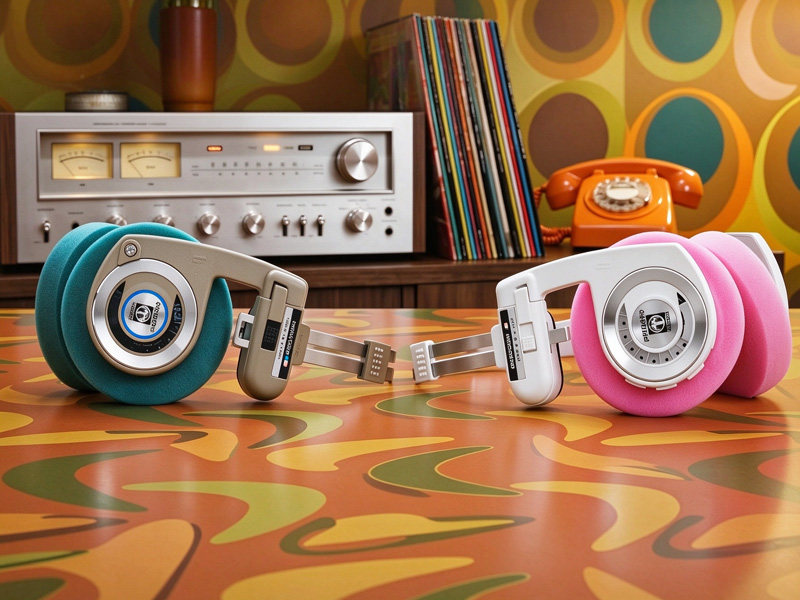
When I browsed, the homepage carried a collection named for the golden age — seventies styling, vintage photography, the copy promising where vintage style meets true high-fidelity audio. Giving the past its own department is catalog architecture aimed on the nostalgic and the curious alike: the retro models are not discontinued relics but current inventory with period styling, the vintage campaign imagery sells authenticity rather than irony, and the store has converted its own archive into a revenue stream. The past is a product line, and it never goes out of stock, and it never needs a refresh cycle because it was never new.
A Transparent Pair With Modern Guts
Among the new releases sits a pair that splits the difference between decades — transparent housings in unmistakable nineties style, the copy announcing that retro is back, but with a modern connector and an inline microphone. Updating the classic without altering its silhouette is design conservation aimed on the customer who wants the look without the inconvenience: the transparency shows the components like the original, the modern interface works with today's devices, and the store has served both the purist's eye and the pragmatist's phone. The transparent shell is the time machine; the USB-C is the return ticket; and the passenger is the nineties kid who finally has a phone jack again.
A Flagship That Snaps
At the top of the line sits a new flagship with a feature borrowed from furniture rather than audio — magnetically attached cushions, the ear pads clicking onto the cups with magnets rather than clips. Using magnetic attachment in a category defined by friction-fit is ownership experience aimed on the user who replaces pads seasonally: the magnets make the swap a snap rather than a struggle, the pads become accessories rather than consumables, and the flagship has quietly innovated on the part that touches the customer most often. The magnet is the innovation; the ear is the beneficiary; and the beneficiary never has to think about the innovation, which is what innovations are for.
A Warranty That Outlives Trends
The service menu carries a standing promise the industry rarely matches — warranty repair, printed as a menu item rather than a fine-print concession. Maintaining a repair channel is longevity aimed on the customer who remembers when things were fixed rather than replaced: the warranty says the company expects the headphones to last decades, the repair bench says the expectation is operational, and the store has converted after-sales service into a brand pillar. The warranty is the promise; the repair bench is the proof; and the proof outlives every trend the industry invents to make the promise unnecessary.
A Price for Every Gift
The collection page offers a filter no spec-sheet store would think of — gifts organized by price bands, from under twenty-five dollars to under a hundred and fifty. Sorting by gift budget rather than by technical category is a buying guide aimed on the shopper who knows her budget but not her drivers: the bands convert anxiety into a short list, the price ceiling respects the giver's constraint, and the store has mapped its catalog to the calendar of birthdays and holidays. The price band is the gift guide, and the gift guide is the second-largest traffic source in audio, and the second-largest source is the one that keeps the lights on.
A Category for Every Ear and Use
The navigation forks beyond product type into use — education, healthcare, gaming, studio, work-from-home — each landing on a curated slice of the catalog. Organizing by use case rather than by acoustics is market coverage aimed on the institutional and the personal buyer: the school district finds the education line, the clinic finds the healthcare line, the gamer finds the headset, and the same factory serves the audiophile and the call center without apology. The use case is the map; the map has no dead ends; and the no-dead-ends map is what a seventy-year-old factory looks like when it refuses to retire.
The Factory That Builds for Others
The footer hides a service most consumers never see — OEM and ODM custom headphones, the company's invitation to other brands to build on its manufacturing. Advertising the white-label service is scale proof aimed on the industry rather than the customer: the OEM desk says the factory runs at volumes beyond its own catalog, the custom program says the engineering is for hire, and the store has quietly told the consumer that the expertise behind the brand is a commodity other companies pay for. The OEM desk is the flex; the consumer is the beneficiary; and the beneficiary pays consumer prices for industrial engineering, which is the oldest trick in the family-business book.