INH hair store review: what to know before you buy hair extensions online

Official homepage: https://inhhair.com
Hair-extension stores usually sell commitment — the installation appointment, the maintenance routine, the months of wear before the pieces come out. INH Hair sells the opposite: the homepage's first promise is a number, five minutes, and the transformation is not permanent but instantaneous — a ponytail, a bun, a half-up piece that clips in before the coffee cools. I browsed with a calendar full of weddings and a vanity drawer full of bobby pins, and a curiosity about what a store looks like when it treats hair like an accessory rather than a project. Here is the counter, decision by decision.
Door Policy: Five Minutes, Printed First
The storefront opens with its use-case rather than its product — a promise that anyone can change style, texture, length, volume, or color in five minutes, illustrated with before-and-after photographs that show the exact arithmetic of the change. Leading with the transformation time rather than fiber quality targets the customer shopping for an occasion rather than a lifestyle: she does not want to learn about wefts and beads, she wants to know if the ponytail will survive the dance floor, and the store answers her actual question before she has to ask it. The clock is the pitch, and the pitch is five minutes long.
Names Instead of Numbers
The catalog's pieces carry first names — the Emily, the Jordynn, the Sammy — each a pre-styled archetype rather than a specification sheet. Naming pieces after people is attachment aimed at the customer who thinks in characters rather than codes: the Emily is a sleek waves ponytail, the Sammy is a bun for thin hair, and the customer who finds her hair-twin among the names has already imagined herself wearing the piece. The names turn a SKU into a persona, and personas are easier to love than product codes, and loving a persona is the beginning of a collection.
A Fave for Every Problem
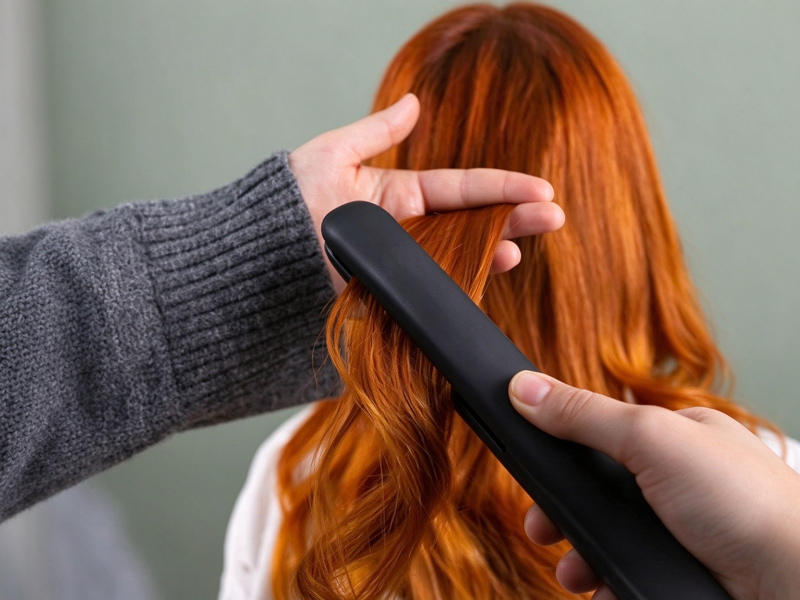
Among the product tags sits one that names a pain point directly — thin hair fave, printed on the bun that adds volume where volume is missing. Tagging products by their solution rather than their features is search architecture aimed at the customer shopping her problem: the woman with fine hair finds the Sammy without knowing what a weft is, the woman with a wedding finds the party-perfect pair without knowing what a claw clip is called, and the store converts pain points into purchase paths. The tags are the store's way of saying it knows why she came, and the knowing is the conversion.
Before and After, Side by Side
Every product carries a small circular inset — the before, the customer's own hair — beside the after, the same head wearing the piece. Pairing the photographs this tightly is a proof format aimed at the skeptic who suspects the model's volume is genetic: the inset says the transformation is achievable on an ordinary head, the scale of the change is visible in a single glance, and the customer who recognizes her own hair in the before photograph cannot unsee the after. The inset is the most persuasive square inch on the page, and the page knows it.
The Badge from the Beauty Aisle
Several products carry a circular badge announcing availability at a major beauty retailer — the store directing its own customers to a competitor's shelf. Publishing the retail partnership is credibility aimed at the first-time wig buyer: the major chain's name is a quality filter she already trusts, the badge says the product survives professional scrutiny, and the store's willingness to share the customer says the brand is confident she will return for the pieces the shelf does not carry. The badge is the co-sign, and the co-sign is worth more than the commission it costs.
Party Kits, Pre-Assembled
The seasonal shelf bundles pieces with their own tools — the ponytail paired with the curling wand, the bun paired with the smoothing stick, the full party collection with the clips and bands, each bundle priced with the savings printed beside the components. Pre-assembling the kit is cart completion aimed at the occasion shopper: she arrives needing one thing for Saturday, discovers the bundle costs less than the sum of its parts, and the store converts a single purchase into a ritual kit she will reuse at every event after. The bundle is the upsell that feels like a favor, and favors get remembered longer than discounts.
Accessories as the Gateway
Below the hair sit the accessories — bow clips under ten dollars, jeweled bands, pony cuffs, the party-prep line that turns a good hair day into a finished look. Pricing the accessories at impulse levels is a traffic loop aimed at the browser not ready for a fifty-dollar ponytail: she buys the clip, wears it, receives the compliment, and returns for the hair that makes the clip look intentional. The accessories are the store's front door for the hesitant, and the front door is priced at seven dollars and fifty cents, and seven dollars and fifty cents is the cheapest first date in beauty.