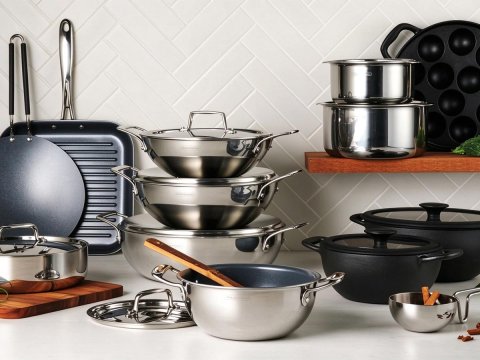
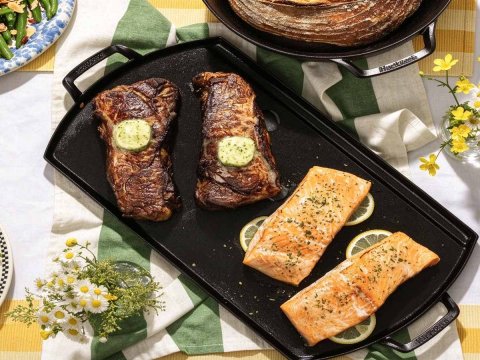
Caraway cookware, examined: what two years of reviews say about the instagram pan
Official homepage: https://carawayhome.com
Cookware stores usually lead with heat. Caraway leads with fear — specifically, the founder's. The New York City brand launched in late 2019 after Jordan Nathan left a PTFE pan on a burner, walked away for forty-five minutes, and came back to a blackened pan, flu-like symptoms, and a call to poison control that diagnosed "Teflon flu." The company he built from that incident sells ceramic-coated aluminum cookware in roughly a dozen colors, wrapped in an influencer marketing machine so effective that the pans became the default "aesthetic kitchen" purchase of the early 2020s. I went through the Shopify store as someone who cooks nightly and has watched the ads for years. Here is what each dimension revealed.
A Scorched Pan and a Case of Teflon Flu
The origin story is the brand's entire sales pitch compressed into one anecdote, and the storefront tells it well. Nathan's response to his poisoning wasn't to buy different pans but to build a company around the category he wished existed — ceramic nonstick, which had sat on retail shelves for a decade with nobody explaining what it was or why it mattered. The insight was narrative, not chemical: the technology already existed, but the story didn't. Five years on, that decision has scaled Caraway from a single cookware line into bakeware, food storage, kettles, utensils, and even a clad stainless line, all unified by the non-toxic mission and a recently added anti-microplastics push. The mission reads genuine — third-party labs, published testing, PFAS-free messaging held up under scrutiny — even as the marketing around it has grown louder than any pan could be.
The Coating Science Behind the Nonstick Promise
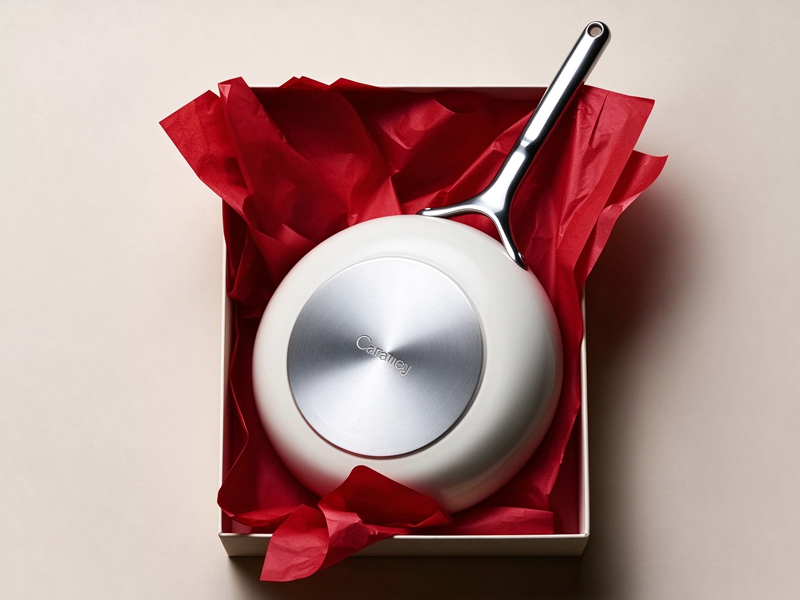
The product itself is straightforward: heavy-gauge aluminum bodies with stainless steel bases and handles, coated in a proprietary sol-gel ceramic layer that contains no PTFE, PFOA, PFAS, lead, or cadmium. When reviewers request the test data, Caraway sends it — Light Labs results showing no detectable forever chemicals or heavy metals, which is more transparency than most competitors offer. Performance out of the box is genuinely excellent: eggs glide without oil, cleanup takes a paper towel, and the magnetic base makes the pans nominally induction-compatible. The honest caveats come from the category, not the brand. Ceramic coatings demand low-to-medium heat, no metal utensils, and hand washing. The store's own guidance says preheat for no more than ninety seconds. What that means practically is that the pans are engineered for a specific cooking style — gentle, deliberate, nonstick-first — and buyers who sear at high heat will cook the coating's life away in months.
Storage Organizers as a Founding Design Thesis
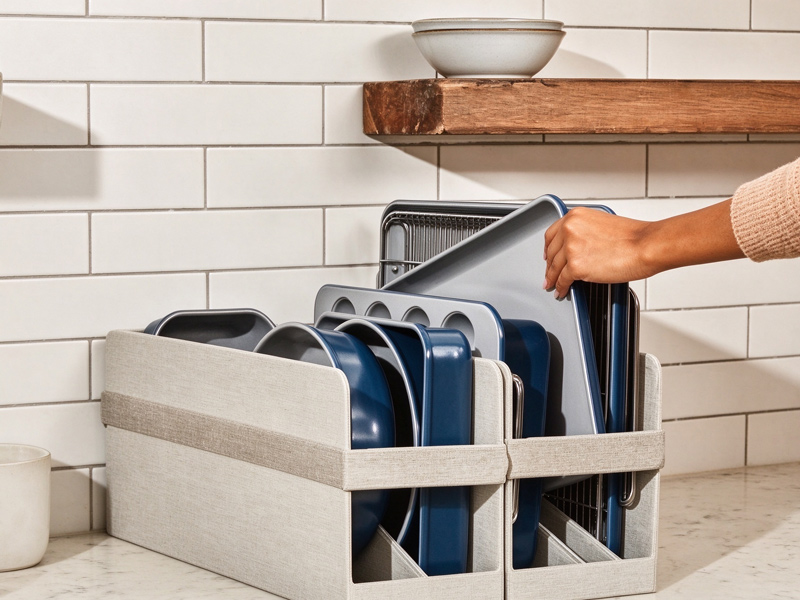
The detail most cookware reviews skip is the one Caraway designed its sets around. Every cookware set ships with a magnetic pan rack that holds pans vertically in a cabinet and a canvas lid holder that hangs on a door with grommets — storage hardware treated as part of the product, not an accessory. The thesis is demographic: the brand's first customers were millennials in small apartments whose kitchens had no drawer space and no tolerance for stacked, scratched pans. It is a genuinely clever bit of customer insight, and it solves a real annoyance that legacy brands ignore. The same small-space logic shows up in the Dutch oven's compact footprint and the kettle's slim silhouette. Whether the organizers survive years of cabinet abuse is a fair question — canvas and glued magnets are not heirlooms — but as a first-impression differentiator, the storage solution sells the set before the coating does.
Twelve Colors and an Influencer Machine
Caraway's true product may be its funnel. The pans photograph almost suspiciously well, and the brand built its early growth on Instagram and TikTok influencer seeding at a scale that turned "Caraway aesthetic" into a recognizable kitchen genre. The storefront mirrors that energy: color swatches are the first decision, photography is editorial-grade, and the shopping experience feels closer to browsing a fashion label than a hardware store. The retail expansion has followed the same playbook — from DTC exclusivity into Crate & Barrel, Nordstrom, Macy's, Target, and Walmart shelves, with the irony that a brand born criticizing mass-market nonstick now sits next to it in big-box aisles. The marketing claims have also faced scrutiny: "non-toxic" is defensible here, but the implied durability has been tested publicly, and not always kindly.
What Long-Term Testing Actually Reports Back
Here is where the review has to be honest. Short-term testing is unanimous — the nonstick performance is superb, cleanup is effortless, and the pans look beautiful on a stovetop. Long-term reporting is mixed in a predictable pattern. The Strategist noted sticking developing after roughly nine months. Food & Wine warned the coating eventually chips or peels. Epicurious found surfaces scuffing quickly. Independent two-year testing observed chips appearing within the first year even with careful use, and noted that because the substrate is aluminum rather than clad stainless, significant coating wear raises aluminum-exposure questions no marketing page mentions. The pans also run hotter in the center than the edges under sustained heat, and induction compatibility draws complaints from owners whose cooktops can't grab the thin magnetic plate. None of this makes Caraway worse than its ceramic peers — it makes it exactly like them, which the gorgeous storefront doesn't advertise.
Warranty Length, Sales Math, and Big-Box Shelves
Pricing follows the DTC playbook: the seven-piece cookware set lists at $545 and perpetually sells around $395, which means the strikethrough price is the real price and patience is assumed. Individual pieces run $60 to $140, squarely premium for aluminum-based ceramic. The fine print that deserves bold type is the warranty — one year, US only, among the shortest in premium cookware, and a telling detail for a brand whose coating has a known finite lifespan. Returns are straightforward within the window, and the big-box retail presence means many buyers can see the colors in person before committing, but it also means price comparison across channels is a chore. The rational buyer's math is simple: you are paying for design, the safety story, and two to five years of superb nonstick performance — not for a pan your grandchildren will inherit.
Pretty Pans With an Expiration Date, Bought Anyway
Caraway earns its cart for a specific cook: the style-conscious home chef in a small kitchen who cooks gently, washes by hand, and replaces nonstick on a schedule anyway — and who would rather the two good years look like this. For that buyer, the color range, the storage system, the verified safety testing, and the genuinely excellent out-of-box performance justify the premium over GreenPan or a $100 big-box dupe. It disappoints the high-heat cook, the buy-once shopper, the induction owner with a picky cooktop, and anyone who reads a one-year warranty as a confession. This is a store that understood the modern kitchen is as much a photographed space as a functional one, and built its entire product — coating, colors, canvas organizers, and all — around that truth. The pans will eventually wear out. The aesthetic, judging by every kitchen feed on the internet, already hasn't.