Bioblo's honeycomb hall: dual eco-seals, one-euro manuals, two-hundred-euro custom colors, brexit jokes inside

Official homepage: https://bioblo.com
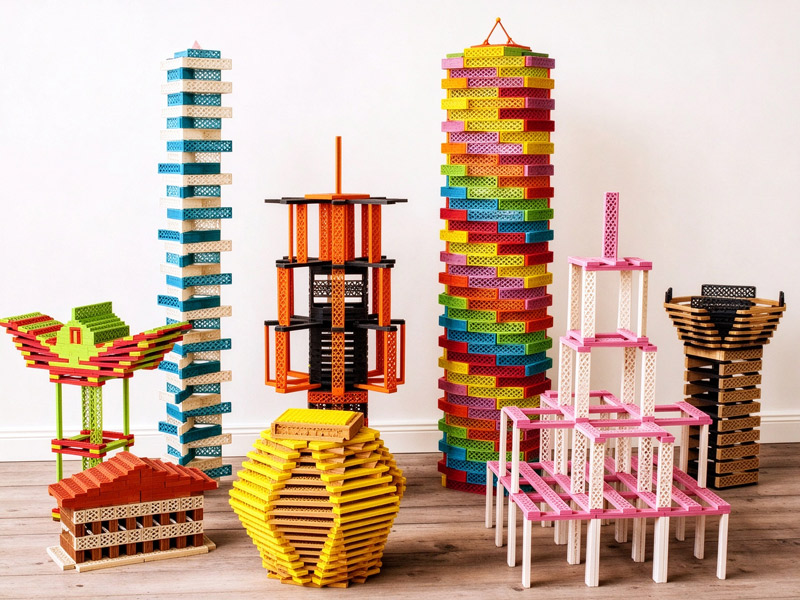
Building-block stores usually organize by theme — space, castles, animals. Bioblo organizes by a single geometric conviction: the honeycomb. Every piece in the store is a flat plate punched with hexagonal voids, and the entire catalog — entry boxes, big boxes, custom-color barrels, one-euro instruction booklets — is the same plate multiplied, colored, and stacked. I browsed with a soft spot for toys that admit what they are, and a suspicion that Austrian engineering applies to play as rigorously as to everything else. Here is the counter, decision by decision.
Door Policy: One Shape, Taken Seriously
The storefront opens with the honeycomb itself — the hexagonal lattice explained as the design's entire logic, the one part that connects to every other part in every direction, the geometry that makes towers breathe and bridges stand. Committing a whole store to a single punched plate behaves like a patent: every product on the shelf is instantly recognizable as the same idea in a different quantity, the pieces a child owns today connect to the pieces she receives next year, and the shape itself becomes the brand before the logo does. The hexagon is the product; the store merely counts it, and counting is the catalog.
Dual Seals Above the Door
The about page carries a claim treated as a point of national pride — the first and only toy manufacturer to hold both the Austrian eco-label and Germany's Blue Angel, two seals that audit materials, production, and durability separately. Stacking both seals at the entrance targets the parent who has learned that eco-claims are cheap: two governments have checked the factory, the seals stand for product quality as well as virtue, and the word only does the competitive work advertising usually must. The seals are the marketing department, and they never sleep, and they never lie.
The One-Euro Library
The all-products page hides the store's quietest invention — instruction booklets priced at a single euro each, nine characters from Blobi and Blibo to Rusty Robo to a stilt house, each a photographed build with step-by-step pages. Selling instructions for a euro instead of giving them away targets the child who has finished the obvious builds: the euro is small enough to spend without asking, the booklet substantial enough to feel owned, and each new character a fresh reason to pull the box back out. The library converts boredom into another euro and another afternoon, and the afternoon converts into another booklet.
Two Hundred Euros of Your Favorite Colors
The flagship listing is a barrel of six hundred blocks in your favorite colors — a configurator with twelve honeycomb swatches, the customer's own palette mixed into a felt-sided tub at a price that crosses into furniture territory. Offering a custom-color bulk set targets the grandparent and the classroom: the child chooses her own palette, the set becomes unmistakably hers, and the two-hundred-euro price lands as a once-a-childhood purchase rather than a repeat one. The configurator turns a commodity into a portrait, and the portrait hangs on the shelf next to the toy box.
Bits as the Entry Rung
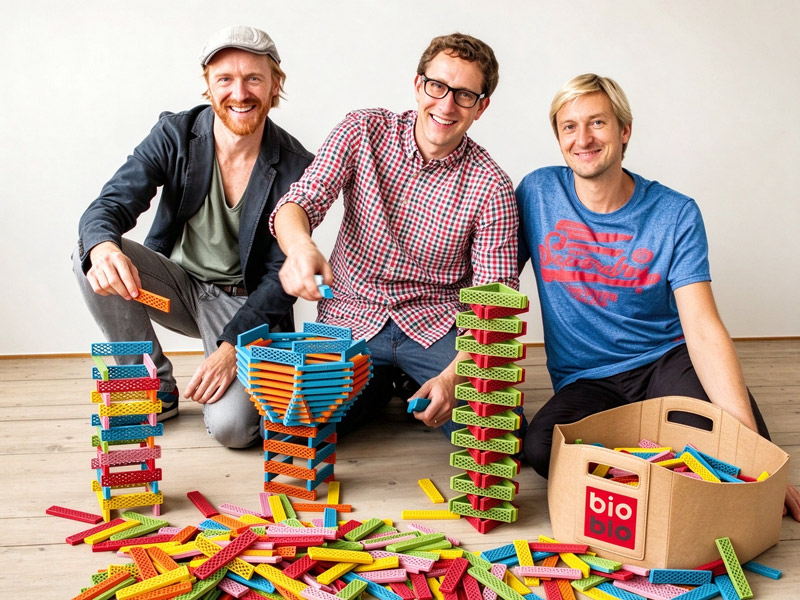
Below the barrels sit the small boxes — fifty-block sets with names like Betty Bat and Charles Chicken, priced at twenty euros and shelved beside the hundred-euro-plus flagships. Maintaining an entry line this small targets the gift buyer testing the waters: the fifty-block box fits a birthday budget, the named character promises a finished build on day one, and the child who masters the bat returns for the barrel. The bits are the handshake; the barrel is the relationship; the handshake is priced for a stranger, the relationship for a godparent.
A Poetry of Numbers
The about page prints a four-line verse — a tower of two thousand blocks requires patience, a bridge of two hundred requires skill, a city of twenty requires self-confidence, an airplane of two requires imagination. Framing the catalog as a poem of descending quantities targets the parent reading aloud: the numbers map the product line, the virtues map the reasons to buy, and the child who asks for the two-thousand-block tower has unwittingly requested the virtue of patience. The poem is the price list, translated, and the translation sells better than the original.
The Brexit Apology
Tucked at the top of the shop page sits a line of candor — no shipping to the United Kingdom at the moment, sorry folks, working on it. Publishing a logistics failure with a joke targets the customer conditioned by corporate euphemism: the store admits the gap, explains it in a phrase, promises a fix without a date, and the honesty reads as competence rather than weakness. Most stores hide what they cannot do; this one puts it on the door and keeps the trust anyway, because a door that admits its own drafts is a door you believe the rest of the time.