Tracksmith's amateur counter: running class, collegiate colors, and a hare that means it

Official homepage:https://www.tracksmith.com
Running stores usually open by promising speed. Tracksmith opens by naming its customer: an independent running company “for the Running Class,” the non-professional who still logs dark miles chasing a personal best nobody will televise. The door copy even reclaims amateur to its original meaning — someone who runs for love. I browsed with a half-marathon PR I never quite hit and a soft spot for shops that treat obsession as a trade.
The Positioning Clause on the Door
Founded in 2014 by Matt Taylor and shaped visually by Luke Scheybeler, a Rapha co-founder, the brand splits its own name into store policy: track is the commitment to training and racing, smith is the obsession with quality and function. That sentence governs the stock. Nothing here is gymwear or loungewear; every item is club kit for people who keep a training log. The positioning is so specific it works as a filter, and the shop seems content to lose everyone who fails it.
The Mascot as a Store Mark
The hare named Eliot is the quietest fixture in the building. No neon, no athlete grin — a small leaping mark that signals agility and nerve. On product cards it behaves like a lapel pin: a membership sign you either recognize or learn. It turns a $20 sock into the same statement as a $150 jacket, which is exactly how a uniform store raises baskets without raising its voice.
Shelves That Read Like a Meet Program
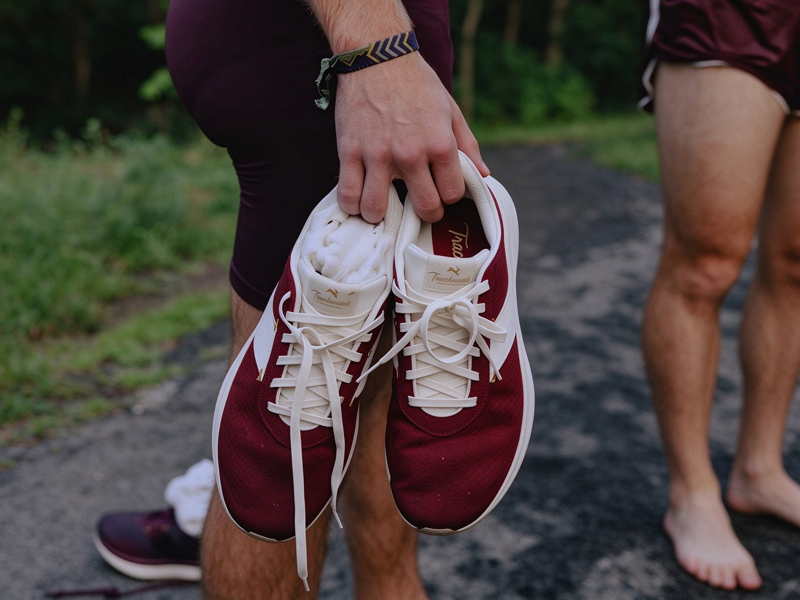
The catalog walks a clean price ladder — $20 merino tube socks, $110 and $120 reverse-weave crews, a $150 Van Cortlandt windbreaker — with colorways named like cross-country courses: Wisdom Gray, Wild Wind, Cabernet, Dark Olive, Vintage Violet. Naming does the conversion work a hex code never could; a customer chooses “Cabernet” the way a runner chooses a race. Low-ticket accessories act as the club’s honest entry fee, and the ladder keeps the premium top end from feeling like a locked door.
New Arrivals Without Alarm Bells
New styles land as events, marked plainly on the cards, with review counts riding alongside. No countdown theater, no fake scarcity, no streak-driven discounting. Collections simply turn over like seasons, and the store trusts the customer to notice. Restraint is the promotion.
Editorial Stocked on the Aisles
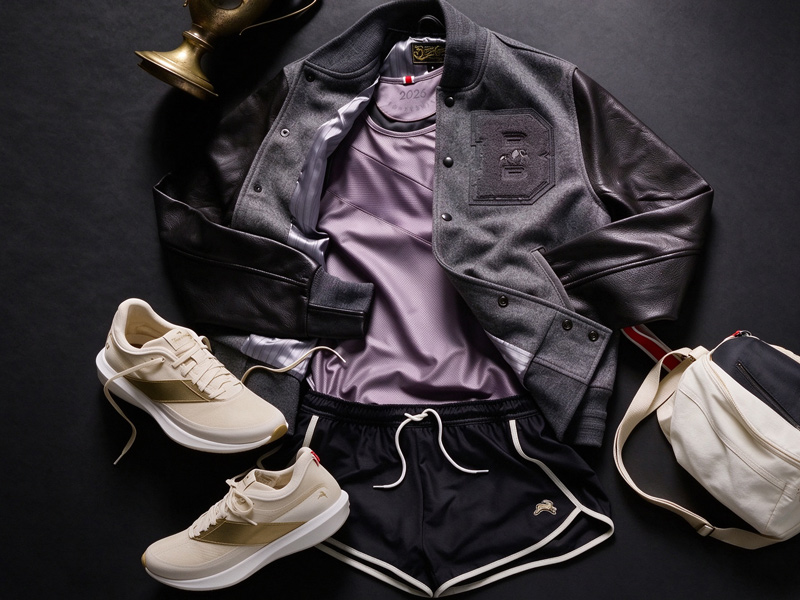
The shop is editorial-heavy by design: rich photography and product stories sit beside the racks, so browsing reads like paging a club yearbook. Training logic is assumed — warmth layers, race-day shells, rest-day fleece — and the copy addresses an initiate rather than a beginner. Content is not a blog bolted onto commerce; it is inventory on permanent display, doing the work a fitting room would do in another category.
The Clubhouse as Collateral
The site keeps pointing at physical rooms: the Trackhouse on Newbury Street in Boston’s Back Bay, opened in 2017, hosts weekly group runs and meetups, with sister rooms in London and New York. Those addresses serve as collateral for the web shop — proof the club has keys, payroll, and a front door. Regional storefronts are the same fixture set translated into new neighborhoods.
The Register, Unrattled
At the register the tone holds: prices stated plainly, no screaming bundles, no exit-intent pleading. The store assumes the customer is serious, stocks the uniform accordingly, and lets the hare close the sale from the corner of the card.