Supply, with precision: the engineer's razor and the guarantee that isn't
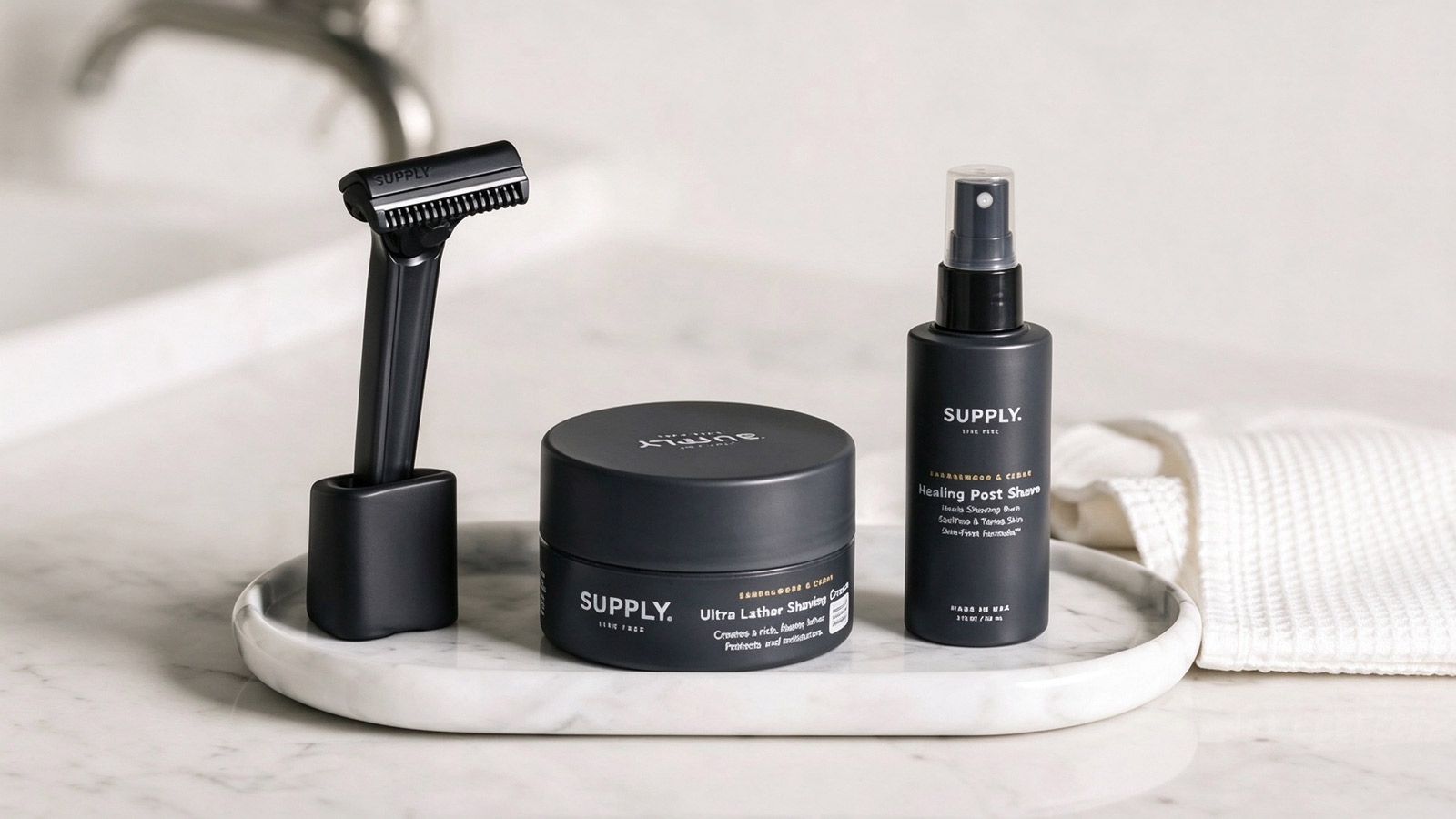
Official homepage: https://supply.co
Men's grooming stores usually sell you a shave. Supply sells you a physics lesson with a lifetime warranty attached — one solid-steel blade, machined to the tolerances of the jet fighters its founder used to sell, mounted in a handle heavy enough to do the work your wrist was never supposed to. The Fort Worth company was a Lockheed Martin side hustle that became a Shark Tank deal that became a half-million-unit brand, and its thesis is printed on the homepage in the register of a manifesto: your barber never used five blades, the industry added blades to sell more cartridges, every added blade meant more friction and more irritation, and one blade held at the right angle cuts once at the skin's surface. The Single Edge asks more of you than a cartridge does, the copy admits — that's the point. I went through the engineering, the funding history, and the complaint file that says the guarantee has a shipping clause. Here is the store across its dimensions.
Selling Jet Fighters, Building a Better Razor
The origin is engineer-quixotic in the best way. Patrick Coddou spent eight years climbing the ladder at Lockheed Martin — his last job was selling jet fighters to overseas accounts, a phrase that remains the most improbable resume line in the grooming industry — while his face suffered the standard multiblade warzone of razor burn and ingrown hairs. His reinvention drew on his grandfather's Schick Injector: a blade twice as thick as the double-edge standard, sharp enough to wipe hair away like a straight razor, but housed in a modern machined body that solved the original's cumbersome disassembly. His wife Jennifer, whom he met at Lockheed, joined the venture; the 2015 Kickstarter cleared $78,278, the follow-up campaign for the second generation raised $256,092 in forty-five days, and a road-trip decision in 2017 turned the side hustle into the whole job.
Three Kickstarters and One Shark Tank Deal
The funding record is unusually public. Three Kickstarter campaigns — the original razor, the 2.0 redesign, and a leather-goods dopp kit at $32,223 — built a community before the retail channel existed, and the November 2019 Shark Tank appearance converted it: a $300,000 deal with Robert Herjavec that the company's FAQ still confirms with visible pride. The same FAQ answers the skeptical buyer's real questions with unusual candor — yes, there is a learning curve; most men have the angle down within five to ten shaves; the thirty-day guarantee runs longer than the curve. The current catalog centers on the $59-to-$79 Single Edge SE and MAX, a $129 starter set with the full ritual, and a trimmer bundle, with the MAX's pivoting head aimed at veterans and the SE's fixed head and micro-finned NickStop geometry aimed at converts.
One Blade, Made in Seki City, Costs a Dollar
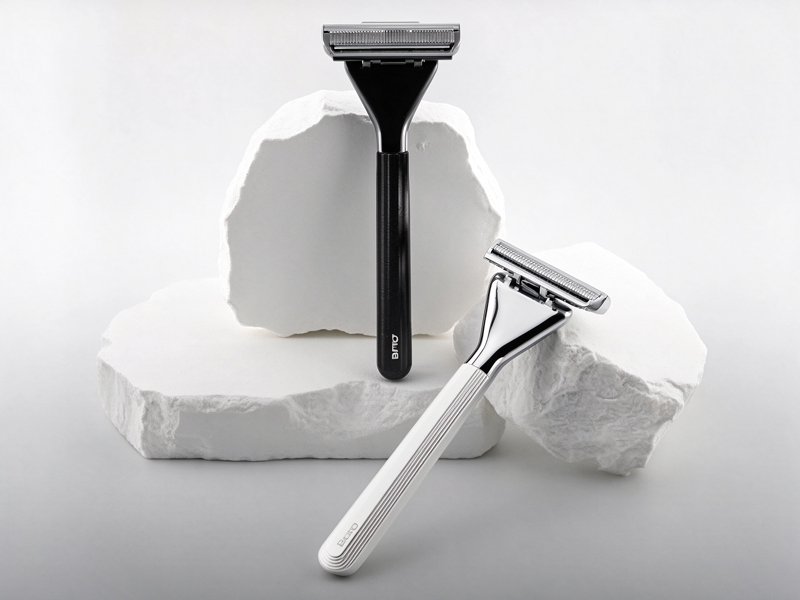
The blade economics are the quiet masterstroke. The razor takes standard injector blades — a format in continuous production for a century, available from Supply or anywhere else — and Supply's own are solid steel made in Seki City, Japan, twice as thick as a conventional blade for less flex and a cleaner cut, at roughly a dollar each with eight to ten shaves per blade. Against cartridge math that runs to three or four dollars a blade lasting a week, the arithmetic inverts within months; the homepage's promise that a fresh shave costs about a dollar a blade is not marketing flourish but ledger. The loading mechanism answers the one legitimate safety objection to single-edge shaving: an insertion key ejects the old blade and seats the new one without a finger ever touching an edge.
The Learning Curve, Disclosed on the Homepage
The honest pedagogy deserves credit. Where competitors hide the adjustment period in fine print, Supply prints it above the fold and quotes the wet-shaving community's dean, whose fifteen-year publication's review called the SE forgiving, drama-free, and very effective — while the surrounding copy concedes the same reviewer's original caution about the prototype: the razor's mass provides less feedback than lighter instruments, and over-shaving is the beginner's characteristic error until the wrist learns the weight does the work. The weight is real — reviewers describe a five-ounce tool whose balance is exceptional but whose grip can turn slippery when wet, and the stand costs six dollars extra. Technique is the price of admission, and the store says so in advance, which converts the learning curve from a complaint into a contract.
Thirty Days, Return Shipping on You, Nowhere Abroad
The policy stack is where the guarantee narrows. The written terms: thirty days from delivery for a trial, original shipping non-refundable, return shipping the customer's responsibility — no returns at all beyond the window — and, decisively, no international returns for any reason, explained as the logistics of cross-border returns and customs. The guarantee language that saturates the marketing is therefore an American guarantee in practice: a British buyer whose order took two weeks and whose razor disappointed has no exit except resale, and the unprompted record shows some of them using the word scam. The thirty-day clock also runs against the five-to-ten-shave learning curve the company itself prescribes — generous on paper, tighter in the mirror.

The Trustpilot Cluster Refunds Refuse to Ignore
The complaint file is recent, specific, and convergent. A buyer who returned within the window and chased the refund three times without response; another who filed a Federal Trade Commission complaint over the gap between the advertised no-questions guarantee and the undisclosed return-shipping cost the company refused to cover; refill orders that sat in processing for a month while the buyer returned to his old razor; a beard trimmer dismissed as four times the price of an equivalent competitor; a lost order resolved with a partial refund that shorted eight pounds against the receipt. Balanced against the engineering credibility — the Shark Tank record, the half-million units, the 4.7 stars across four thousand reviews the homepage displays, the honest learning-curve disclosures — the pattern reads as a company whose product department outran its service operation: the razor keeps its promises, and the inbox sometimes does not.
Heavy, Slippery When Wet, and Worth the Weight
The physical critique is short and survivable. The five-ounce body is an asset once technique clicks and a liability until then — slippery when soaped, unforgiving of drops, and stand sold separately. The fixed-head SE cannot adjust to different growth patterns the way dial razors can; the MAX's pivoting head exists for exactly that complaint. None of it disputes the central claim that one blade, properly handled, irritates less than five blades mechanically dragged across the same cheek.
Buy the SE, Learn the Angle, Keep the Receipt
Supply is the grooming store that treats its customers like engineering adults: the physics is real, the Seki blades are cheap, the learning curve is printed on the homepage, and the lifetime warranty covers the razor's life rather than the buyer's patience. Buy the SE if you are patient, the MAX if you are experienced, the starter set if you are gifting; buy only from the American store if you live abroad, because the guarantee ends at the border; document every email if you must return anything; and give the razor its ten shaves before judging it — the company says so itself, and for once the marketing is the honest part.