Stomping at stomp rocket: kid-powered physics, thirty-year dino heads, foam-tipped trajectories, screen-free summers
Official homepage: https://stomprocket.com
Outdoor-toy stores usually promise battery-powered spectacle — lights, sounds, motors. Stomp Rocket promises the opposite, and prints the promise in its most visible sentence: one hundred percent kid powered. No batteries, no cords, no charging — a foot stomps a pad, air rushes up a tube, and a foam-tipped rocket climbs toward whatever weather the afternoon offers. I browsed with a lawn, a niece who has never known a toy without a screen, and a soft spot for anything that turns physics into a game. Here is the counter, decision by decision.
Door Policy: The Anti-Battery Manifesto
The storefront's founding claim is a negative — no batteries, no cords or plugs — printed before any product name appears. Leading with subtraction targets the parental fatigue the rest of the toy aisle manufactures: every blinking gadget needs charging, updating, and eventual disposal, and the opening sentence promises a toy that runs on nothing but a child's leg. The manifesto does the segmenting — the family wanting quiet simplicity finds it at once, and the family wanting lights leaves without hard feelings. The negative is the entire pitch.
Thirty Years of Unchanged Physics
The copy claims more than three decades of stomping, and the mechanism is unchanged in principle — air compressed by a foot, a column lifting a foam rocket, children running through grass. Keeping a thirty-year-old toy essentially intact is a product-integrity decision: the physics never needed improving, the nostalgia belongs to parents who stomped the same pads as children, and the store can sell to two generations from a single product page. Longevity is the feature competitors cannot duplicate, and the store wears it like a patent.
The Launch Stand as Physics Classroom
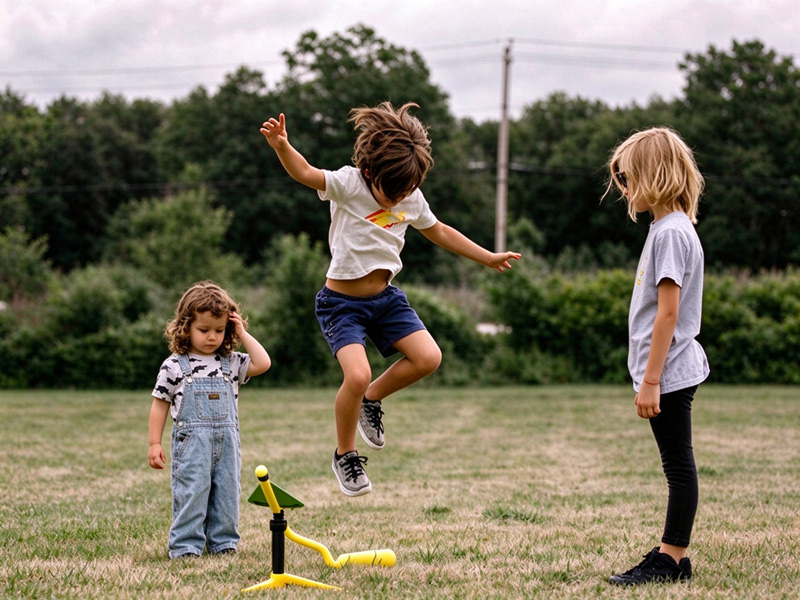
Every set ships with an adjustable stand, and the copy argues it explicitly — children experiment with trajectory and force, sending rockets straight up or hurtling across the yard, beginning a journey into STEM. Framing a stomp toy as science education aims at the parent who needs the purchase to mean something: the afternoon of shrieking and stomping becomes an experiment in angles and air pressure, and the toy survives the guilt audit frivolous outdoor games sometimes fail. The launcher teaches while pretending to only play, which is the only kind of lesson a six-year-old accepts.
Rockets With Names and Faces
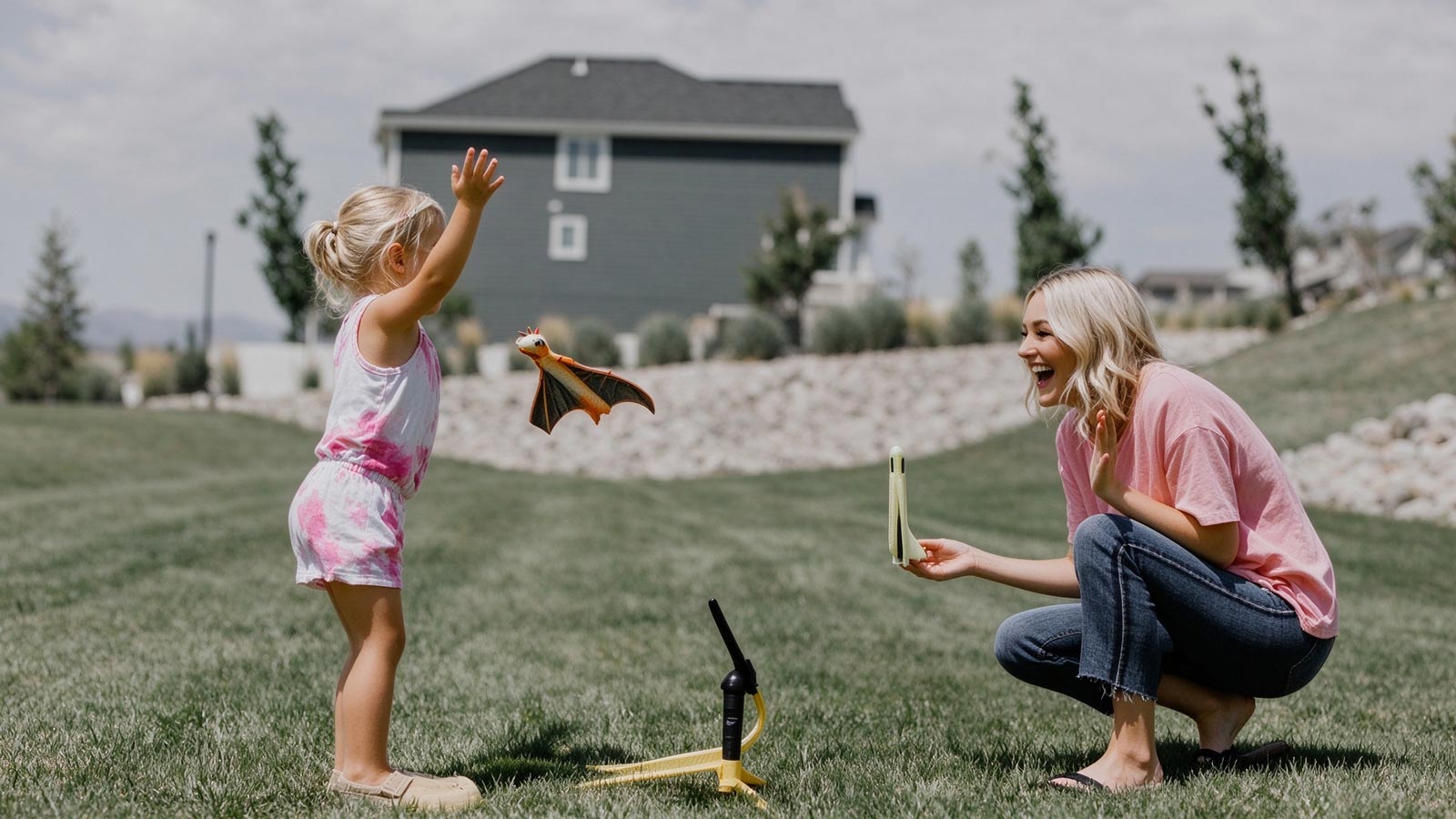
The newest set abandons generic foam cylinders for named characters — a raptor, a triceratops, a T-rex, each with a rubbery head and foam fins, each apparently with a personality. Characterizing the consumables targets the youngest stompers: a child who loses a rocket named Riley searches the yard longer than one who lost a red tube, and the trio format — three rockets per set — quietly acknowledges one will end up on a roof by sundown. The names turn replacements into reunions, and the replacement purchase into loyalty.
Safety Engineered Into the Materials
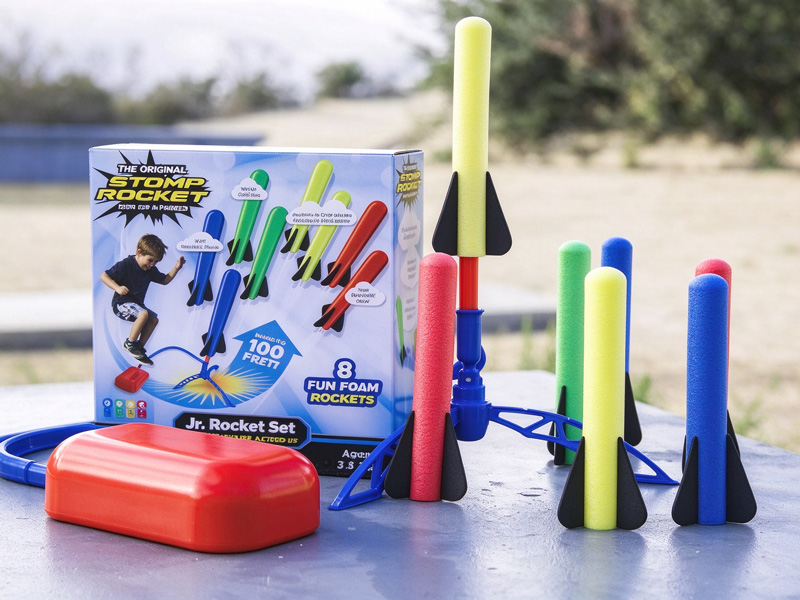
The product details read like a materials lecture — plastic bodies, foam fins, soft rubbery heads, designed for the most active stompers. Specifying soft components throughout addresses the adult standing nearby: the rockets travel fast enough to thrill and softly enough to forgive, the stomp pad tolerates the heaviest uncle, and the whole system stays safe because nobody in the engineering meeting was allowed to say sharp. Safety is not a warning label here; it is the material specification, and the specification is the marketing.
Height as a Progression
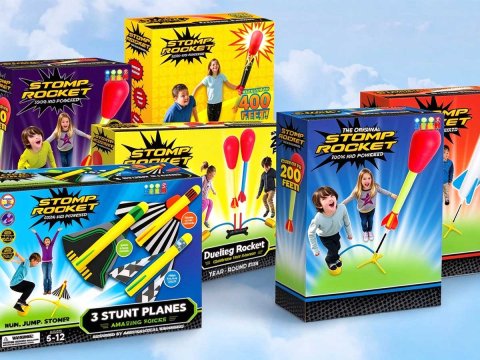
The catalog offers a ladder of altitude — standard sets for the backyard, an ultra set rated for four hundred feet, the dino set for the youngest legs. Stacking sets by performance builds a repeat-gift path: the three-year-old stomping dinosaurs graduates to the standard set, the standard stomper graduates to the ultra, and each birthday has a pre-written answer. The child's trajectory through the catalog mirrors the rockets' trajectory — upward, with increasing confidence and increasingly sore neighbors.
The Screen-Time Opposition
The marketing closes its loop with the sentence every parent waits to hear — more active outdoor play, less screen time — printed beside children mid-jump in actual grass. Declaring war on screens sells the afternoon rather than the launcher: the purchase reallocates the child's attention, and the store positions the stomp as the antidote to the exact device the parent is holding. The enemy of the product is the phone in the room, and the product wins by being more fun than the feed.