Stomp rocket, skyward: thirty years of kid-powered physics in a foam tube
Official homepage: https://www.stomprocket.com
Outdoor stores usually sell motion the child generates with batteries. Stomp Rocket sells motion the child generates with a sneaker. The Irvine, California company's launcher is almost insultingly simple: a flexible bladder you stomp, a tube of compressed air, and a foam-tipped rocket that rides the pulse upward — one hundred feet on a standard set, two hundred or more on the performance lines, no batteries, no cords, no apps, nothing to charge and nothing to break that costs more than a lunch. The company behind it, D&L, has been manufacturing that exact experience for more than three decades, which makes Stomp Rocket one of the oldest unchanged physics toys still in active production — and one of the few that physical-education catalogs and science museums stock next to the curriculum materials. The current storefront leads not with the classic set but with a new character line — three dinosaurs named Riley, Trixie, and Theo — proof that thirty years in, the brand still thinks like a toy company. I went through the physics, the curriculum connection, and the one complaint that has followed the product since the beginning. Here is the store across its dimensions.
A Bladder, a Tube, and a Hundred Feet of Air
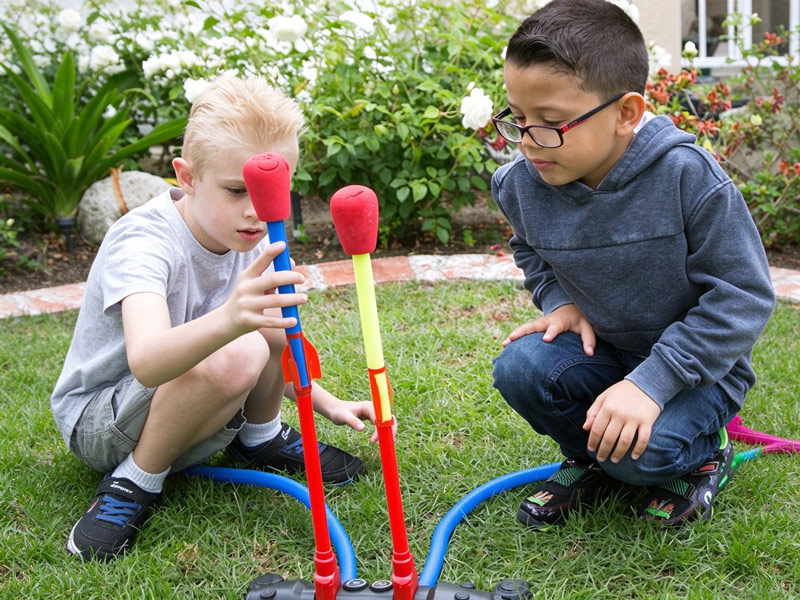
The mechanism is the entire product and the entire lesson. A child stomps the rubber bladder, the bladder pushes a column of air through the launch tube, and the rocket — a hollow foam body with soft fins and a rubbery nose — rides the pressure gradient off the top and into the sky. The physics that makes it educational is the physics that makes it fun: the relationship between stomp force and launch height is immediate, linear, and honest, and the adjustable launch stand lets children experiment with trajectory angles the way a medieval siege engineer tested trebuchets. Standard sets claim flights to one hundred feet; the performance Ultra and X-Treme lines push two hundred to four hundred feet for older children and competitive adults. Retail packaging says what physics teachers know: a harder stomp is not the only variable, and watching a rocket underperform a well-aimed gentle stomp teaches more than any worksheet.
The Curriculum Connection Most Toy Stores Skip
The brand's institutional life is its quiet superpower. Stomp Rocket sets appear in teacher stores and science-museum shops, the company's own materials pair the launcher with a companion science book, and the copy on every product page makes the pitch explicitly: experiment with gravity, force, and trajectory, and start the journey into STEM. The product survives curriculum audits because it is honest — the air pressure that launches the rocket is the same physics as piston engines and water rockets, scaled to a child's sneaker — and because it requires no consumables beyond the rockets themselves, which are cheap, brightly colored, and deliberately foam-soft enough to survive nose-first meetings with pavement. In an era when screen-free play is a parental selling point, the company has a thirty-year head start on the trend.
Thirty Years of Iteration From Original to Dino
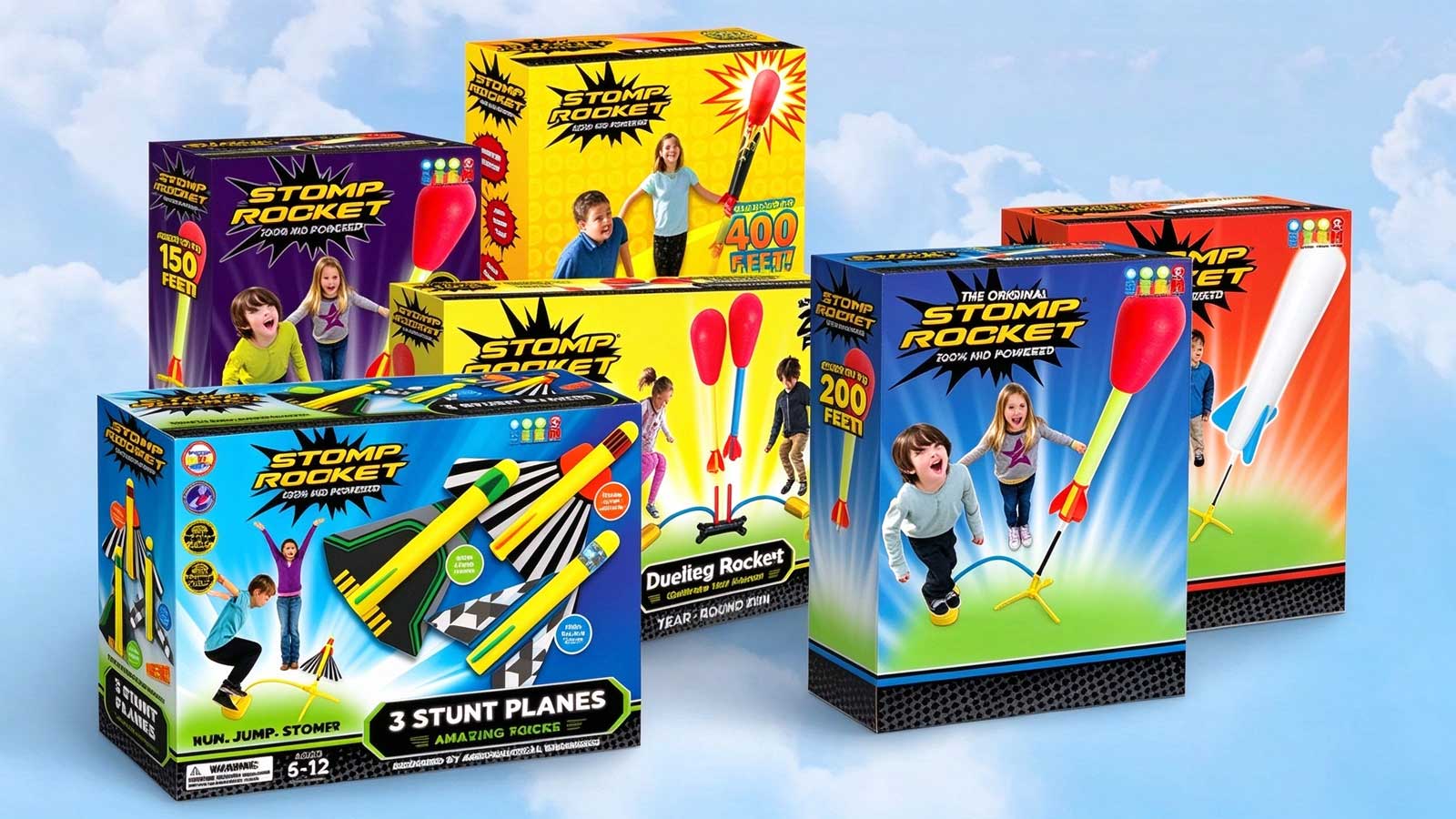
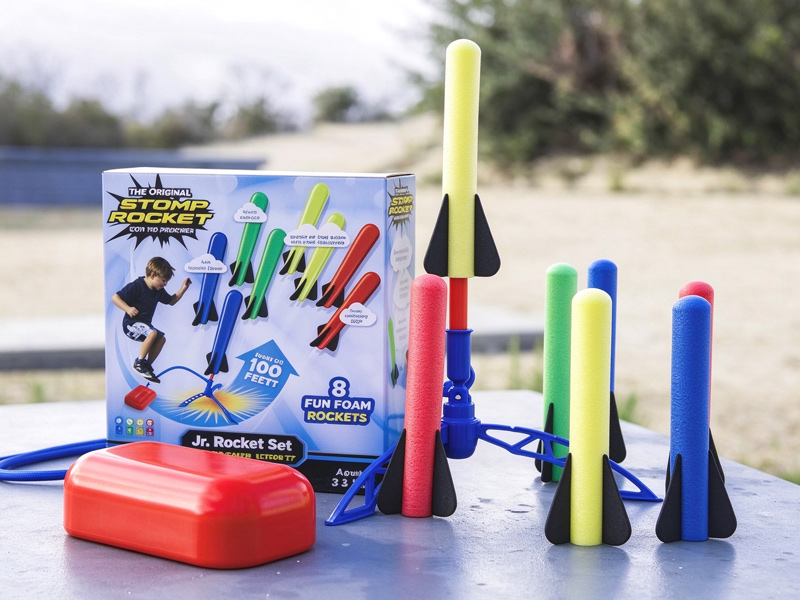
The catalog evolution tracks the brand's dual life as backyard staple and gift discovery. The classic Original and Ultra sets remain the backbone — four rockets, a stand, a bladder, twenty to thirty dollars, the same formula for three decades. Around them have accreted the Night Flight sets with glow-in-the-dark and LED-lit rockets for evening play, the Dueling Rockets sets for simultaneous launches, the Stunt Planes line whose glider wings trade altitude for hang time, the Stomp and Catch variant that adds a net for throwing-and-catching games, and the distance-class X-Treme sets. The newest entry, Dino-Soar, targets ages three and up with three rubbery-headed dinosaurs — a raptor, a triceratops, and a T-rex — soft enough for the youngest stompers and characterful enough to anchor a gift. Each iteration keeps the same bladder-and-tube physics; none requires a manual.
The Base That Tips Over When You Need It Most
The honest complaint file is remarkably stable across thirty years of reviews, and its top entry is the launcher's stability. Multiple long-term owners describe the same sequence: the stand, light by design for portability, tips over on uneven grass or under the recoil of an enthusiastic stomp; one two-year owner noted the connecting hose stiffens with age and the base falls over unless it is weighted or steadied. Reviewers offer the same folk solutions — a brick, a sandbag, a foot on the frame — and the company has iterated the base repeatedly without fully solving the physics of a lightweight object absorbing a child's stomp. The second complaint is entropic: rockets, being light and aerodynamic, migrate to rooftops and tree branches, which is why refill packs exist and why the company wisely sells them in multi-packs. Neither flaw is disqualifying at this price; both recur with metronome regularity in the unprompted record.
Trees Eat Rockets, Refills Stay Cheap Forever
The consumable economics deserve their own paragraph because they are the brand's quiet genius. A four-rocket set launches hundreds of times before the first rocket is lost, stained, or sun-faded into retirement; replacement rockets cost a few dollars each and are stocked everywhere the original sets sell. The LED night rockets draw one durability note — their built-in batteries are not replaceable, so the glow eventually dims into a standard rocket — but even that obsolescence is soft. The result is a toy whose total cost of ownership across a childhood runs to roughly the price of two video games, and whose environmental footprint is a small pile of foam.
The Default Shopify Policy and a Generous Spirit
The storefront runs on the platform's standard machinery, and the policy page says so in the most literal way: the text is Shopify's unmodified default template — thirty days, unused items in original packaging, email-initiated returns, label provided on approval. There is nothing bespoke here and nothing evasive either; damages and issues get immediate attention per the policy, and the exclusions list is the standard one. For a twenty-to-thirty-dollar toy with museum-shop distribution, the vanilla policy is arguably the correct amount of legal infrastructure, and the long tail of owner reviews suggests the company resolves problems the way family businesses do — directly, and without a knowledge base.
No Batteries, No Screens, Just Angles and Force
The positioning paragraph writes itself, which is why the company has used versions of it for decades: in a toy aisle increasingly populated by charging cables and companion applications, Stomp Rocket runs on a child and a sneaker. The marketing copy's pairing with a science book, the adjustable stand's invitation to experiment, and the sheer spectacle of a hundred-foot vertical launch combine into the rare product that satisfies a birthday wish and a curriculum committee in the same box. Parents consistently report the same secondary benefit — the toy that pulls children outdoors and keeps them there, launching and retrieving, estimating and adjusting, for hours that feel like minutes.
Buy the Ultra, Weight the Base, Buy Extra Rockets
Stomp Rocket is the rare outdoor store whose flagship has not needed reinvention in three decades: a stomp, a whoosh, a hundred feet of foam, and a child who just learned something about force without noticing. Buy the Ultra for the best height-per-dollar, the Dino-Soar for the three-year-old, the Night Flight for the sleepover, and the Stompin' Science book for the teacher in your life; add a brick for the base, a spare multi-pack of rockets for the trees, and nothing else — there is no app to download and no subscription to forget. The company has spent thirty years proving that the simplest physics toy is also the most durable, and the dino heads suggest it intends to spend thirty more.