Ratio, the long way: the portland pour-over machine serious eats won't stop praising
Official homepage: https://ratiocoffee.com
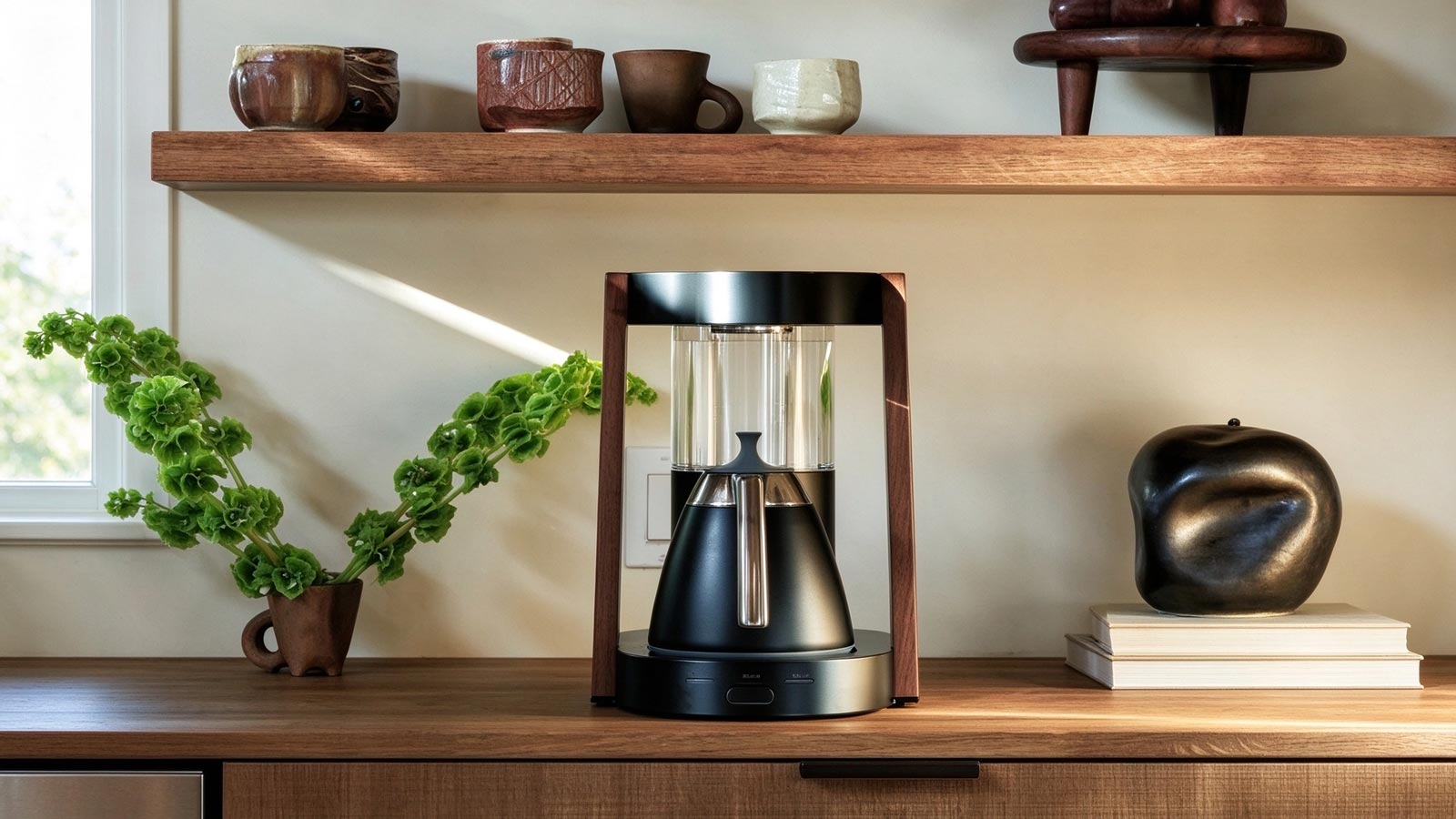
Kitchen-appliance stores usually chase convenience — the pod, the app, the timer you can command from bed. Ratio Coffee sells the opposite: a machine that does less, on purpose, so that what it does — one button, one bloom, one perfect carafe — becomes the best cup in the house. The Portland company, founded by Mark Hellweg as a sibling venture to his celebrated coffee-gear retailer Clive Coffee, spent three years from first sketch to unveiling before shipping a single unit. The first five hundred machines were laser-numbered by hand on a lean production line with a daily quota, and the design brief never wavered: die-cast aluminum, handblown borosilicate glass, real hardwood — a plastic-free brew path in a category drowning in plastic. A decade on, the press wall reads like a coffee-maker hall of fame, the warranty runs five years, and the machines have converted devoted Moccamaster owners in public. I went through the doctrine, the praise, and the lukewarm complaints. Here is the store across its dimensions.
Three Years from First Sketch
The origin is patience as a strategy. Hellweg unveiled the Ratio brewer in late 2013 after three years of development, taking pre-orders at $395 before raising the price to $480 within weeks as demand outran the hand-built line. His materials philosophy was a deliberate rebuke: appliances, he said, had become over-designed, loaded with doodad features, with materials chosen for ease of manufacturing rather than beauty and longevity. The first run of five hundred sold out before manufacturing finished; a second batch of five hundred took reservations into the following year. In a subsequent interview he bought Able, a heritage brewing-equipment maker, as a side project, and when asked why Ratio would never launch a toaster, he answered that the company does few things and does them properly.
Plastic-Free by Principle
The engineering doctrine is the brand's spine. Every Ratio routes hot water through borosilicate glass and stainless steel — no plastic screws, tabs, gaskets, or pods touch the brew path, a claim that the testing lab at a major wire service endorsed as coming closer to truly plastic-free than anything else in the category. The Eight, the flagship, automates a proper pour-over: an automated bloom cycle that degasses fresh grounds, a precision showerhead that distributes water in the pulse rhythms top baristas use, full and half-batch recipe modes, and temperature control accurate enough to satisfy people who own thermometers for this. One button. The hardwood trim and matte finishes make it, as one review put it, a machine worth making room for on the counter.
The Wall of Praise
The editorial record is nearly spotless, and worth reading as a set. Serious Eats, after years of testing drip machines, wrote that they had yet to find one that performs better than the Ratio. The Wall Street Journal praised its precise temperature controls and pouring movement that emulates the pulse rhythms of top baristas. Bon Appétit called it simple enough for the most serious technophobe yet good enough to impress an intense coffee nerd — a hard mix to master. Tom's Guide named it among the best drip coffee makers; Sprudge quoted Twin Peaks approvingly — a damn fine cup of coffee; CNET noted the glass-and-wood showpiece is not style over substance. The machines appear in the reviews of people who gave away their Moccamasters, which in coffee circles is close to a religious conversion.
The Line-Up
The catalog is deliberately small. The Ratio Eight anchors the line between roughly five hundred and eight hundred dollars depending on finish, with walnut or oak trim options and the new limited finishes that arrive as pre-orders at fifteen percent off. The Ratio Six, around three hundred forty-five dollars, compresses the same philosophy into a smaller footprint with a thermal carafe. The Ratio Four serves single households. Bundles pair the brewers with grinders and filters for the complete counter. The pricing is unapologetically premium — a coffee maker that costs as much as an espresso machine's foot — and the company has never pretended otherwise.
Five Years, Spelled Out
The ownership terms match the product's longevity pitch. Every machine carries a five-year warranty — the founder cites long-term support as part of the brand promise, alongside good materials. Shipping runs free over ninety-five dollars within the contiguous United States from the Portland warehouse via UPS or USPS, Monday through Friday; coffee-bean purchases, sold alongside the machines, are excluded from the free-shipping threshold, a small line in the policy that keeps the hardware math honest. Returns follow a standard window with the usual unopened-condition expectations for a machine of this price.

The Temperature Complaint
Here is the honest ledger, and it is specific. The collected-review average sits just under four stars across more than four hundred entries, and the dominant grievance is thermal: no warming plate, by design — the company will not stew coffee on a burner — so the last cup of a full carafe arrives closer to room temperature than buyers of hot-plate machines expect. Some reviewers call the output just above lukewarm even fresh. The carafe lid has its own entry: it is removable, easy to forget when reinstalling, and forgetting it creates what one reviewer called a major mess, since nothing flows through the sealed lid into the pot; removing the carafe mid-brew also requires holding the brew basket, a two-handed operation that surprised people. The handblown glass earns both praise and breakage reports — one owner's carafe shattered and a replacement's cover broke soon after, prompting a question about glass quality that the warranty answers but the shipping does not ease. And the company does not ship to Hawaii.
Who Buys a $700 Coffee Maker
The audience is the design-led coffee person: someone who owns a burr grinder, reads Serious Eats, and wants the ritual without the pour-over gymnastics at 6 a.m. — and who values that the machine on the counter will still be there, still brewing, in fifteen years, which is the arithmetic the five-year warranty and the materials doctrine are selling. Compared with a Moccamaster, the Ratio trades some of the Dutch machine's utilitarian charm for sculptural presence; compared with pod machines, it trades convenience for taste in a way its owners consider non-negotiable.
Bottom of the Pot
Ratio Coffee is the appliance-store answer to planned obsolescence: three years of design patience, a plastic-free brew path almost nobody else attempts, a five-year warranty on a machine hand-assembled in Portland, and a press wall that Serious Eats anchors with the single strongest endorsement in drip coffee. You accept a coffee that cools faster than diner coffee, a carafe lid with opinions, and a price that requires belief. Buy the Six if you brew for two, the Eight if you host, and the thermal-carafe habit if you linger over the second cup — the machine will outlast the lesson.