NZXT store review: what the three-register layout and flex rental mean for buyers

Official homepage: https://nzxt.com
PC hardware stores usually open with a configurator — pick a CPU, a GPU, a case, tick forty boxes, pray it fits. I browsed nzxt.com expecting that same parts-list maze, given the brand's 20-year history in the builder community, and instead found a store organized around three registers: buy a Player PC, subscribe to a Flex PC, or take a refurbished one home. For a Computers-category shopper, that's the whole thesis. Here's the store, decision by decision.
A homepage that bet against its own configurator
NZXT actually built the infinite-choice configurator, ran it, measured it, and shut it down. In its own telling, the custom builder converted at half the rate of its standard prebuilts — customers wanted curation, not a thousand permutations — so the company retired the tool, rebuilt the store on Shopify's standard architecture, and slimmed the whole catalog down to a focused selection. The All Products page currently lists 76 items. That's a rare thing to see on a hardware site: a store that chose less choice, on purpose, and treats simplicity as the headline feature rather than an apology.
A catalog organized like game difficulty
The Player line is merchandised the way games sort their own modes: Player One for smooth 1080p, Player Two for 1440p, Player Three for high-end 1440p and 4K, with numbered tiers continuing up to a 5090 Edition flagship built around an RTX 5090 and a Ryzen 7 9800X3D. When I browsed, the entry Player One sat at $1,499 on sale with an Intel i5-14400F and RTX 5060, and the Player One Prime at $1,749. Organizing machines by resolution instead of part numbers tells the store's target customer — the player who doesn't want to spec parts — exactly which shelf to walk to. The part names become the sales staff.
Three tills for three ways to own a rig
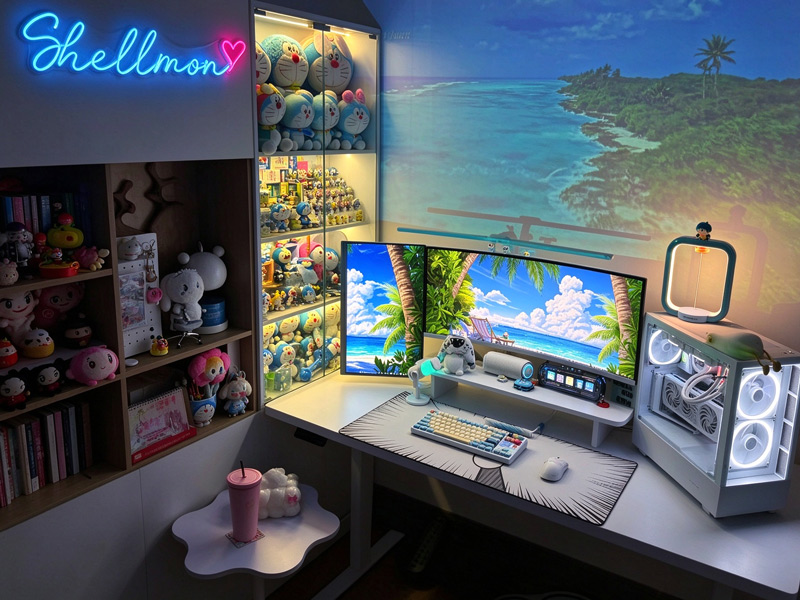
The Gaming PCs collection page doesn't push you toward a product; it pushes you toward a payment model. Player PCs are the buy-outright till. Flex is a month-to-month PC subscription — swap tiers, refresh, or cancel anytime, with no hard credit check and shipping included — starting around $84 a month for the entry tier, with a like-new refurbished unit as the default and a fee if you insist on factory-new. The refurbished till sells certified pre-owned systems rebuilt and retested under the same warranty banner as new. Renting a gaming PC is still a strange idea to much of this audience, and giving subscription equal visual weight with ownership is the store betting that access will outgrow possession.
Promotions priced around the subscription door
The standing headline offer isn't a discount on hardware — it's 50% off your first month of Flex. Sale pricing does appear on the Player machines (the Player One's $1,499 tag read as a marked-down price when I browsed), but the promotional energy clearly leans toward getting a rig into your home on a rental basis first, letting the monthly relationship do the rest. It's a customer-acquisition structure borrowed from streaming services rather than from retail, which is fitting for a store that also bundles a one-month PC Game Pass trial with every gaming PC.
Trust fixtures for a four-figure purchase
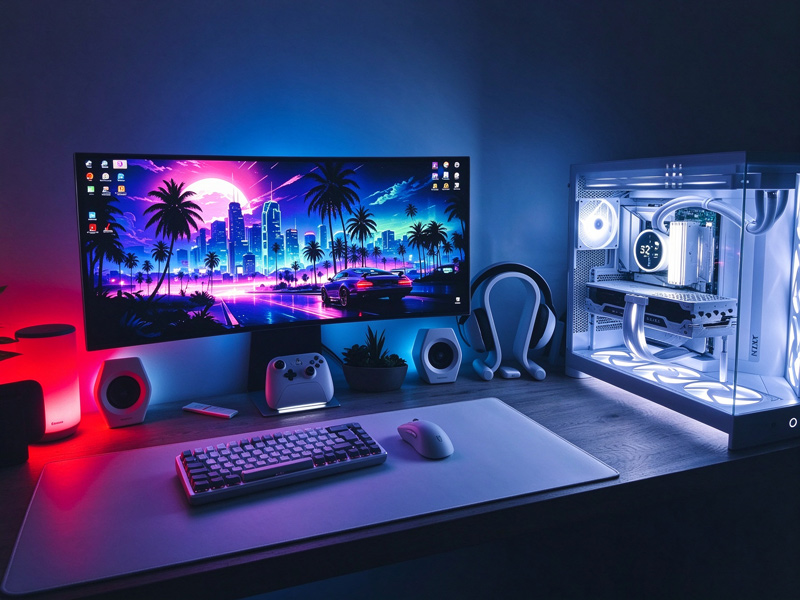
Nobody impulse-buys a $1,500 computer, so the store loads its pages with reassurance hardware: star ratings with real counts attached (the F120 RGB Duo triple pack showed 4.6 stars across 245 reviews while I browsed), a "Built by Specialists" block promising hand assembly, clean cable management and multi-point inspection, and a two-year parts-and-labor warranty on gaming PCs as a baseline. Every gaming PC also carries the one-month Game Pass trial. These aren't decorations — they're the store's answer to the question every prebuilt shopper silently asks: who exactly built this, and what happens when something goes wrong?
A policy desk with a warranty ladder
Returns run through an RMA process inside a 30-day window, with the store reserving the right to deny returns on used or modified gear — standard for hardware, stated plainly. The more interesting fixture is the warranty ladder: two years as the floor for cases, cooling and peripherals, stretching to six years on Kraken X and Z liquid coolers, and ten years on Gold-series power supplies. Tiered coverage like that is really a product strategy — it tells builders which components NZXT expects to last, and it quietly argues that a PSU is a longer commitment than a GPU.
Checkout built on a platform decision
Underneath the merchandising sits an operational one. NZXT moved off its custom headless architecture onto Shopify Liquid in a project it called "Project Spark Joy," and the payoff it cites is concrete: fulfillment times that once stretched to ten days on custom orders now run under two, because curated machines can be pre-built and pre-staged. You can feel that decision everywhere in the storefront — the tight catalog, the resolution-based shelves, the three clean registers. This shop isn't a parts warehouse with a cart bolted on; it's a pre-built PC company that rebuilt its entire operation so the box ships before you second-guess the order.