MEL science shop review: everything to know before buying science experiment kits
Official homepage: https://melscience.com
Educational-toy stores usually choose a side — the screen or the bench, the virtual or the physical. MEL Science refuses the choice: the storefront sells one hundred hands-on experiment kits delivered monthly, and beside them, a parallel library of digital experiences — virtual laboratories, augmented-reality explanations, an app that guides the chemistry with interactive instructions. I browsed with a childhood memory of a chemistry set whose manual assumed a lab assistant I did not have, and a curiosity about what happens when the manual becomes the app. Here is the counter, decision by decision.
Door Policy: Serious Science, Felt as Play
The storefront's thesis arrives in a single phrase — serious science that feels like play — the two adjectives doing equal work, the serious keeping the parents, the play keeping the children. Balancing both in the door is market positioning aimed at the household split between two customers: the parent who wants rigor and the child who wants fun, the phrase says both are present, and the store has converted the oldest tension in educational toys into a single product. The serious is the curriculum; the play is the delivery; and the delivery is what makes the curriculum survive contact with the child, and the contact is the whole point.
The Hybrid as the Architecture
The catalog runs on twin rails — the physical kits arriving by mail, the digital experiences available anytime, the app bridging them with instructions that respond to the experiment in progress. Building the hybrid is product architecture aimed at the parent who suspects a kit of being a one-afternoon novelty: the digital layer says the kit extends beyond the box, the anytime access says the learning survives the weekend, and the store has made the subscription two products wearing one price. The hybrid is the moat; the moat has two walls; and the walls defend each other, and the defending is why the novelty never dies.
The Chemists' Endorsement
The press wall carries a citation the category rarely earns — the American Chemical Society, the professional body, calling the offering a twenty-first-century upgrade of the classic chemistry set, the endorsement printed with the observation that the apps might actually pull children from their game consoles. Quoting the chemists is credibility aimed at the parent who trusts institutions over influencers: the society says the chemistry is real, the game-console line says the competition is understood, and the store has borrowed the authority of the people who invented the subject. The endorsement is the certification; the certification is professional; and the professional authority outranks every star review on the wall, and the outranking is the endorsement's entire job.
Spies and Portals as Curriculum
The kit names abandon the textbook — chemistry for spies, an infinity portal, luminescence, resonance — each box a small adventure rather than a chapter. Naming kits as adventures is engagement aimed at the child who opens the box: the spy says the chemistry is a mission, the portal says the physics is a journey, and the store has converted the periodic table into a shelf of stories. The names are the hooks; the hooks are the lessons; and the lessons are disguised well enough that the child forgets to resist them, and the forgetting is the education.
Two Continents of Safety Standards
The compliance section names both regulators — the American consumer commission and the European standards body, the copy explaining that the chemistry complies with the specific list of substances permitted in children's sets. Naming both standards is trust architecture aimed at the cautious parent: the two continents say the safety is international, the substances list says the exclusions are specific, and the store has turned regulatory compliance into a selling point rather than a footnote. The compliance is the quiet wall; the wall is invisible until it matters; and the mattering is why the cautious parent sleeps, and the sleep is the subscription's silent renewal.
The App as the Missing Assistant
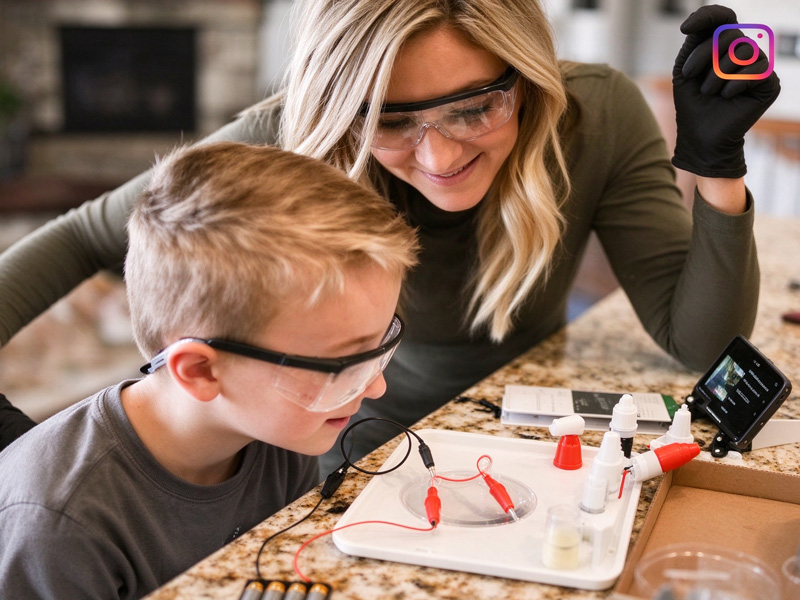
The instructions live on the app — interactive steps, safety reminders appearing exactly when needed, the take-off-your-gloves prompt arriving at the moment the gloves are the problem. Moving the manual into the app is pedagogy aimed at the parent who never took chemistry: the app says the guidance is always present, the interactivity says the guidance responds, and the store has replaced the absent lab assistant with the phone the parent already owns. The app is the assistant; the assistant fits in a pocket; and the pocket is always in the kitchen where the experiments happen, and the happening is the homework that does not feel like homework.
The Wall of Colorful Boxes
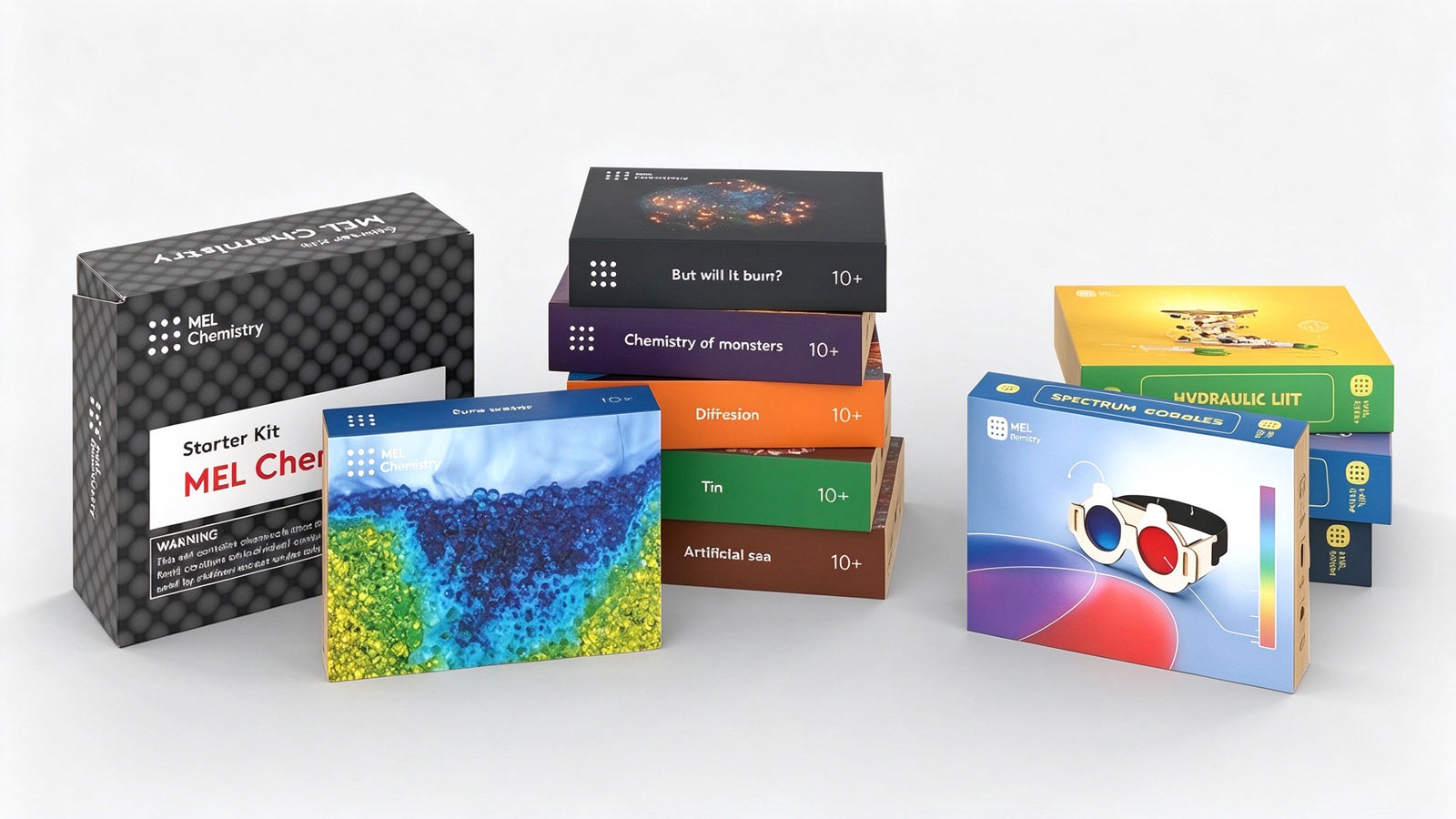
The product photography shows the library — dozens of boxes in stacked columns, each a different color, each a different subject, the collection resembling a shelf in a very fun science museum. Photographing the library is abundance aimed at the browser: the wall says the catalog is deep, the colors say the subjects are varied, and the store has made the entire curriculum visible in a single image. The wall is the proof; the proof is the variety; and the variety is why the subscription renews — because the next box is always a color not yet opened, and the not-yet is the anticipation that pays the invoice.
Pause as a Feature, Not a Trap
The subscription terms arrive in plain sight — pause or cancel at any point, with one click, in the account tab, the reactivation equally easy. Printing the exit is trust aimed at the parent burned by cancellation mazes: the pause says the company expects life to interrupt, the one click says the interruption will not require a phone call, and the store has made the subscription's flexibility its closing argument. The pause is the feature; the feature is the honesty; and the honesty is why the subscription outlasts the novelty of the first box, and the outlasting is the business model disguised as generosity.