Hurom, in depth: the korean company that invented slow juicing, at a price
Official homepage: https://hurom.com
Kitchen-appliance stores usually chase the next function. Hurom invented the function everyone else now copies. The Korean company — whose mission statement begins with the audacious claim that it wants everyone to become the healthiest version of themselves, which is why it invented the slow juicer — spent decades refining a single idea: that juice extracted by gentle pressure at crushingly low speeds retains more nutrients, more flavor, and more color than anything spun out by the blades of a centrifugal machine. Five decades after its founding, Hurom is the category's reference standard, its name nearly generic for vertical cold-press juicing, and its machines sit at the premium end of every juicer roundup on the internet. The Shopify storefront sells that heritage with unusual confidence — a single-button juicer philosophy, a ten-year motor warranty, and a Black Friday promotion running even in October. I went through the invention story, the family tree, and the value question its cheaper challengers keep raising. Here is the store across its dimensions.
Fifty Years to Invent a Category
The origin is corporate patience. While appliance brands chased quarterly features, Hurom's parent company spent decades building motor and plastics expertise before landing on the vertical slow-press juicer concept that now defines the premium juicing category. The company's founding narrative treats slow juicing not as a product line but as a public-health contribution — its homepage mission statement explicitly says the goal is healthier lives, which is why it invented the slow juicer, framing competitors as copiers of an idea Hurom owns. It is a bold framing, and the category's history largely agrees with it.
43 RPM, Explained
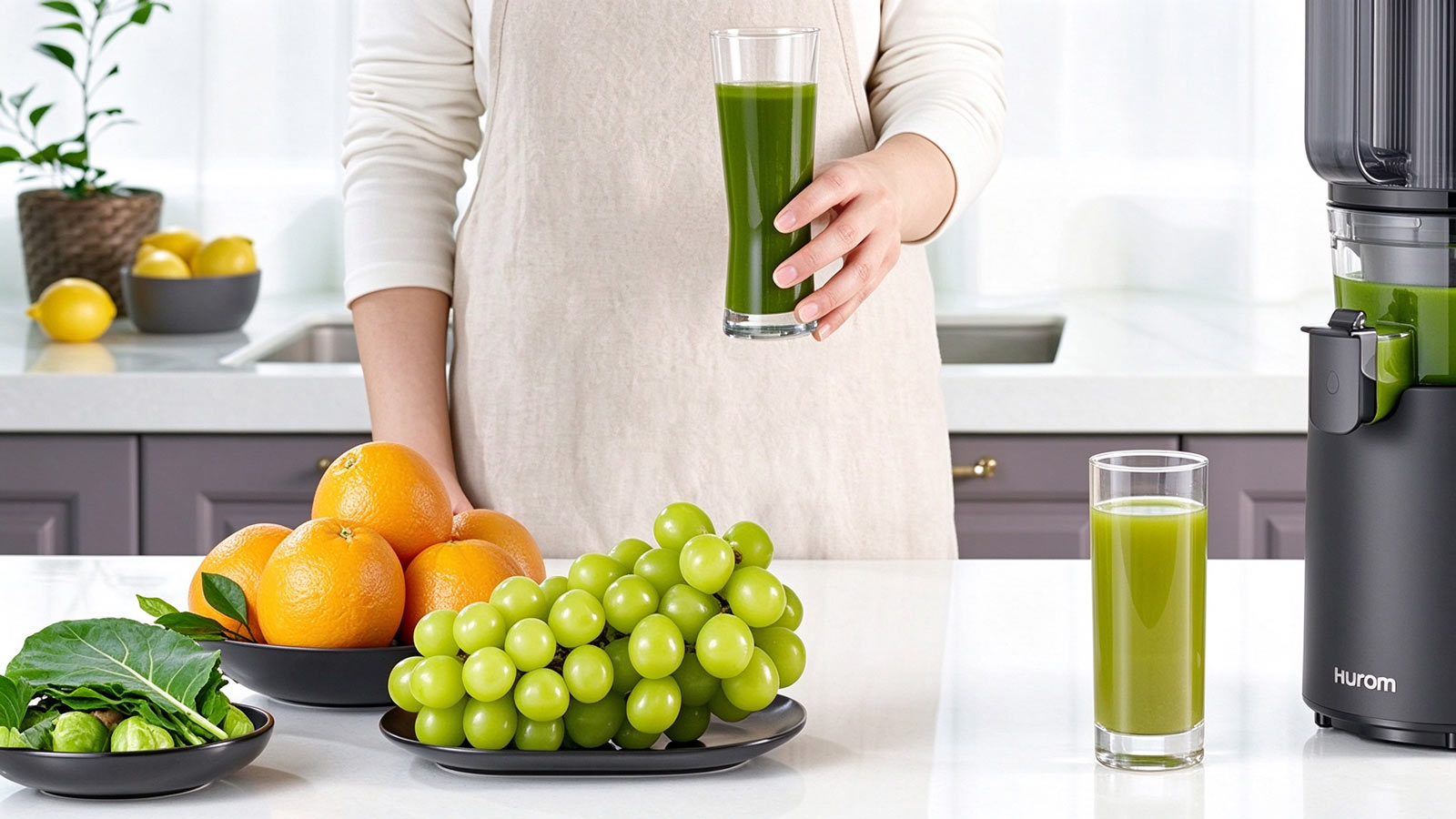
The physics argument is the store's entire pitch. Where centrifugal juicers spin blades at ten thousand-plus revolutions per minute, slicing produce and whipping air into the juice, Hurom's auger turns at 43 revolutions per minute — deliberately mimicking a hand squeezing fruit. The slow crush presses out juice while minimizing the heat and oxidation that degrade enzymes and color, which is why Hurom juice arrives greener and browns slower than blade-juiced equivalents. The engineering underneath is equally considered: an Ultem strainer and auger rated eight times stronger than conventional plastics, a built-in spinning brush that continuously cleans the chamber and strainer during operation to prevent clogging, duplicate safety sensors that refuse to run unless the chamber is perfectly seated, and a chute sized so that even small fingers cannot reach the mechanism. The marketing claim — anything chewable with teeth can be pressed — extends the range from celery and kale to nut milks, sorbets, and even tofu on some models.
The Family Tree
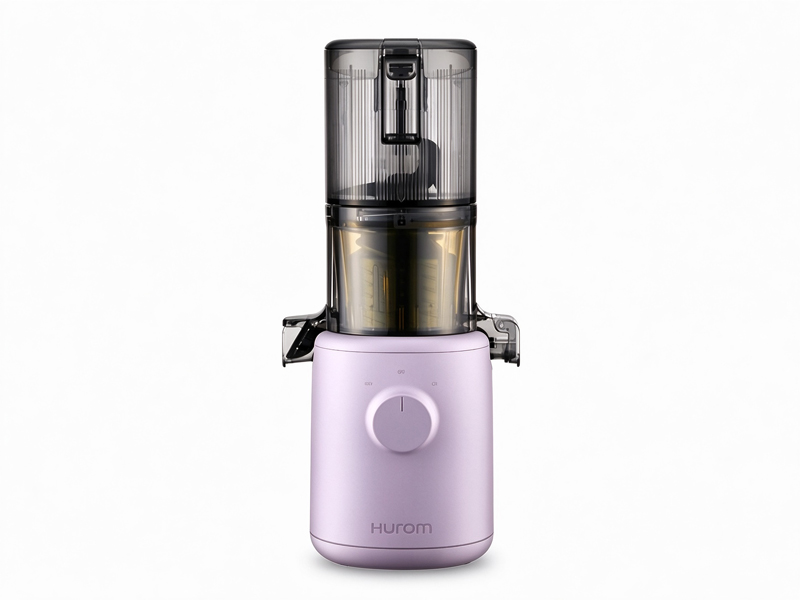
The current lineup maps neatly onto household sizes. The H-AA, at $399, remains the bestseller: 43 RPM, three strainers, ice-cream capability, and the inner spinning brush design, in matte black, white, or rose gold. The Easy Clean line — including the compact H310 at a lower price — answers the category's oldest complaint by re-engineering the chamber for faster cleanup and adding a self-feeding hopper that swallows a small whole apple without pushing. The H320 appears in the site's own testimonials as a customer favorite. For families, the larger-chamber H300 and H400 models batch bigger. Across the line, the versatile promise holds: juice, smoothies, nut milks, and frozen desserts from one machine.
The Yield Question
Here is the honest ledger's first entry, because premium pricing invites arithmetic. Lab testing by TechGearLab found the Hurom produced, on average, almost one ounce less juice than comparably priced rivals — a meaningful margin when organic produce costs what it does. A British review of the H-AA made the same point from the other direction: the $100 Nutribullet Juicer Pro, a centrifugal machine, delivered juice yields surprisingly similar to the Hurom's, at a fraction of the price, with every part dishwasher-safe. Hurom's counterarguments are real — its juice tastes better by near-consensus, stays fresh longer, and handles leafy greens that centrifugals waste — but the buyer who juices apples and carrots for volume should know the mid-market has closed the yield gap.
The Warranty That Leads
The ownership stack is where Hurom justifies its confidence. A ten-year warranty on the motor and two years on parts covers every slow-juicer model, though the FAQ quietly notes the coverage applies only when purchased through authorized channels — a clause worth respecting given the gray-market listings on major marketplaces. The shipping policy shows similar operational polish: orders placed by 11 p.m. Eastern ship the next business day, damage claims must be filed within three days of delivery with packaging preserved, cancellation after warehouse submission carries an intercept fee, and a customer-care line handles defect claims with a troubleshoot-first workflow. Free shipping kicks in at fifty dollars, which nearly every juicer clears.

The Honest Ledger
The remaining critique file, assembled. The feed chute on the H-AA measures roughly four by three and a half centimeters — every apple must be quartered, which adds real minutes to a celery-juice morning and distinguishes Hurom from the wide-mouth Kuvings school. Parts are hand-wash only, and while the spinning brush helps, the fine strainer still wants a brush and thirty seconds of attention. The body is impact-resistant ABS plastic, a sensible engineering choice that nonetheless prompts fair questions at premium prices. And the yield arithmetic above applies most painfully to high-volume juicers, for whom a $100 centrifugal plus a Hurom for greens might be the honest two-machine answer.
Who Juices Daily
The core customer is the daily juicer: the celery-juice devotee, the leafy-greens household, the parent making sorbets on weekends. For that buyer, Hurom's quiet motor, nutrient-retention pitch, and decade-long motor warranty are the purchase arguments, and the prep time is accepted as ritual. The storefront leans into wellness language, seasonal promotions with early-access codes, and a recipe blog that keeps the machine in daily rotation — the retention engine of a company that knows its juicers only justify themselves on countertops where they are used.
Pressed for Time
Hurom is the slow-juicer standard-bearer in the most literal sense: the company that invented the category still defines it, with 43 RPM engineering, a ten-year motor warranty, and a catalog that spans the single household to the juicing family. You pay three to five times the mid-market price, quarter your apples, and hand-wash the strainer — in exchange for the quietest, tastiest, longest-lasting juice the category produces. Buy the H310 if you are new to daily juicing, the H-AA if you are committed, and the H400 if you juice for a crowd; whatever the model, buy it from Hurom's own store, where the warranty clause lives. The invention was Hurom's; the decision, at least, is simple.