He built the $100m supra sneaker empire, then fixed running shorts for good

Official homepage: https://www.pathprojects.com
Path Projects was born when a skateboarding industry veteran bought twenty pairs of running shorts, hated every one of them, and decided the category deserved the same engineering obsession footwear gets.
Scott Bailey is not a typical running brand founder. Before launching Path Projects in 2018, he spent three decades building action sports companies from Southern California garages — Split Apparel, then One Distribution, whose brands KR3W and SUPRA grew into a global sneaker business past $100 million in revenue before he sold it. This review examines how that background produced running's most debated innovation — the separated liner — and whether a four-person, self-funded company can really out-engineer the giants.
Twenty Pairs of Shorts, Zero Winners, One Decision
Bailey's path to running apparel ran through frustration. After selling his company in 2015, he threw himself into trail running and run-commuting, and quickly hit a wall: every pair of shorts he tried chafed, soaked up water, or offered pockets with velcro flaps that lost his keys. He ordered roughly twenty different pairs from every brand he could find. He did not like a single one.
His conclusion was structural rather than cosmetic — running shorts were mostly made by footwear companies as an afterthought, with none of the materials engineering the category deserved. He partnered with Eric Frey, a technical apparel veteran with three decades of experience including Rip Curl, and set out to build the best running short in the world, launching in summer 2017 and formally founding the company in 2018.
Independent Suspension: The Liner Innovation Explained
The innovation that defines the store happened by accident. During fabric testing, Bailey and Frey asked their factory to build liners separately so they could swap materials without rebuilding entire shorts — and realized the separation itself solved running's oldest problem. Sewn-in liners move against the body with every stride, which is where chafing comes from. A separate liner stays put against the skin while the short floats freely on top.
Path calls the concept independent suspension, and it turns one purchase into a system: shorts sold unlined, paired with baseliners chosen by conditions — Tahoe for all-season, Torch for heat, Shasta for cold. Runners who had spent years cutting liners out of their shorts with scissors finally had an official solution, and the chafe-free claim holds up in long-distance testing where it matters most.
Custom Japanese Fabric From the Maker of Kevlar
The material story is unusually deep for a company this size. Path develops custom fabrics directly with Toray, the Japanese textile giant whose fibers also end up in Arc'teryx and Patagonia garments. Its PrimeFlex staple uses spiral-spun yarn that stretches mechanically without spandex, which matters because spandex absorbs and holds water. The ultralight Airtastic models, like the 2.7-ounce Sykes AT, borrow fabric technology from premium insulated jackets.
This is where the co-founder addition paid off. Brian Rather joined from Huckberry, where he ran house brands during the retailer's fastest growth years, bringing the mill relationships that let a four-person company develop proprietary fabric constructions that much larger brands often cannot access.
A Business Model With No Outside Money
Path Projects has never taken outside investment, and Bailey has been public about why: a private equity mentor once told him to run a brand like he is going to own it forever, and the company has operated that way since day one. The team is roughly four people, remote, self-funded, and profitable, with no quarterly pressure to expand SKU counts for the sake of growth.
For customers, the practical effect is a catalog where every product exists because it beat what came before it. The flip side is slower expansion — categories arrive years apart, and popular items sell through — but the anti-landfill philosophy of building fewer, better things is the stated point, not a compromise.
Pockets, Seams, and Details Obsessive Runners Notice
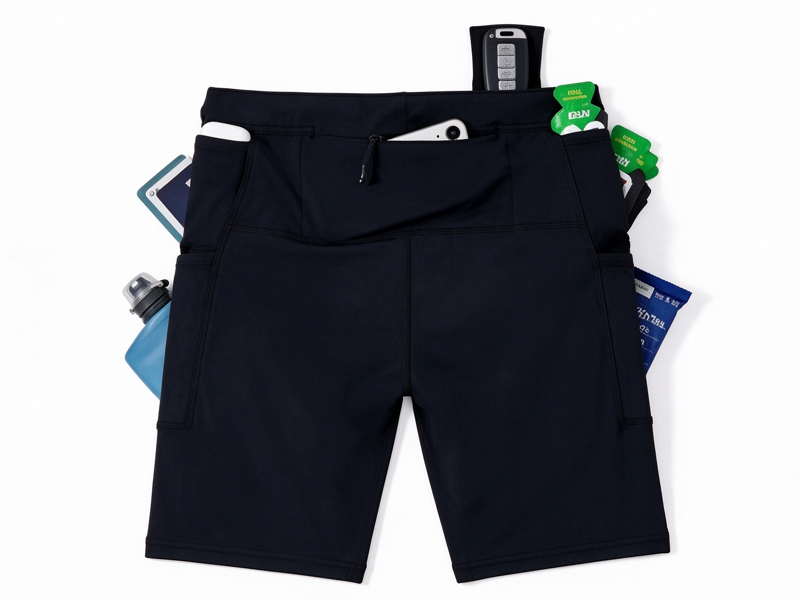
The product pages reward close reading. Shorts carry a no-bounce center back pocket sized for most phones, flanked by zippered side pockets that swallow a wallet and gels, plus a fold-over key pocket. Stitching is mapped to avoid rub points, waistbands use exterior drawcords, and the Pyrenees sun hoodie includes a watch window on the sleeve so runners can check pace without yanking the cuff back.
These are the details of people who actually run long distances, and they accumulate into a product that reviewers consistently describe as solving problems they had stopped noticing. The hoodie fabric story is typical: UPF protection engineered into the knit structure itself rather than a chemical finish that washes out.
Quiet Earth Tones as a Design Philosophy
Visually, Path sits deliberately outside the neon performance mainstream. The palette runs to desaturated earth tones and jet blacks, influenced by Bailey's stated love of mid-century modern design and quiet brands. The design goal, as the team describes it, is the morning-drawer moment — the piece you grab first because it goes with everything and still looks right after years of washing.
This restraint has trade-offs. Runners who want loud race-day kit will find the catalog monochrome, and the aesthetic skews toward a specific minimalist taste. But for the style-conscious trail and ultra crowd that fueled the brand's growth, the understatement is the appeal.

Pricing When Shorts and Liners Cost Separately
The system model complicates the sticker math. The signature Sykes PX short runs about $58 unlined, and a matching baseliner adds roughly $32 — pushing a full setup near $90, which reviewers have flagged as the brand's main drawback. Individual liners can be cheaper than a second lined short over time, and mixing liners across seasons replaces buying multiple shorts, but the upfront total is real.
Positioned against premium competitors and Lululemon-tier pricing, Path lands in the upper-middle of the running apparel market. Buyers chasing the cheapest option will find it elsewhere; buyers treating shorts as multi-year equipment tend to do the math differently.
YouTube Testers and Word-of-Mouth Growth
Path's marketing budget is close to zero, and its growth has come almost entirely from product testing by YouTube gear reviewers and runner word of mouth — a strategy Bailey has credited as the biggest driver of awareness. In a category where giants spend millions on sponsorships, an organic recommendation economy has carried the brand from launch to cult status among gear obsessives.
Customer service follows the same founder-led pattern: Bailey has said there is a good chance a support email gets answered by him personally. For a Shopify storefront, that small-company accessibility is both a service feature and a brand asset that scales awkwardly — which regulars would argue is exactly the point.
Who the Path Projects Runner Actually Is
The Path customer is typically an experienced runner, often trail or ultra oriented, who logs enough miles for chafing and pocket bounce to be real problems rather than hypotheticals. Style-conscious minimalists and gear detail-obsessives gravitate to it, as do runners burned by footwear-company shorts that fell apart at the seams.
The honest summary: Path Projects took one product category nobody was engineering seriously, applied decades of action sports brand-building and Japanese fabric expertise, and delivered a system that serious runners describe as permanently changing what they expect from a short — at a price that asks for commitment. For the right runner, that is precisely the point.