From a trash can at leadville to 40 countries: the tailwind nutrition story

Official homepage: https://www.tailwindnutrition.com
Tailwind Nutrition began with a founder vomiting at the finish line of a 100-mile mountain bike race — and the video proof is still on the company's website.
In 2011, Jeff Vierling, a former Microsoft program manager living in Durango, Colorado, finished his first Leadville 100 after eleven miserable hours and promptly threw up his breakfast into a trash can while his wife Jenny filmed it. That moment launched a company that now fuels endurance athletes across some 40 countries, all from a production facility in Durango where every batch is still mixed in-house. This review covers how a kitchen experiment became a global sports nutrition brand, what is actually inside the scoops, and whether "all you need, all day" holds up for runners and riders.
Eleven Hours of Misery at Ten Thousand Feet
The origin story is unusually well documented because the Vierlings turned embarrassment into marketing. Jeff had trained nine months for the Leadville 100 mountain bike race, arrived fit, and spent the entire day fighting his stomach instead of the course. After crossing the line he walked straight to a garbage bin and brought up the muesli he had eaten thirteen hours earlier — an image Jenny captured on video that now anchors the brand's about page.
Frustration, not entrepreneurship, drove what happened next. He tried nearly every product on the market, found nothing that worked, and started reading sports nutrition research to understand why. The turning point came when he shared early batches with a woman at Leadville who had dropped out of seven consecutive hundred-mile races with stomach trouble; months later she emailed that she had finished the Shenandoah 100 in tears. That email, he says, is when Tailwind became a business.
A Kitchen Mix Built on Digestion Science
The founding insight is physiological. During hard, long exercise, blood flow shifts away from the digestive tract, which is why dense, complex foods sit like rocks in a working athlete's stomach — the "gut bomb." Vierling's research pointed toward the small intestine's active transport mechanisms: pumps that move glucose and fructose across the intestinal wall using sodium as a co-transporter, pulling water along with them.
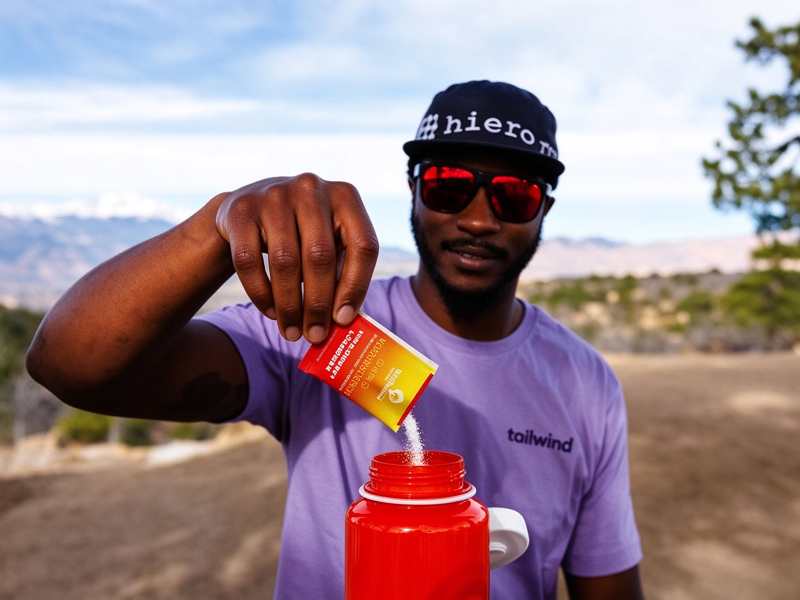
Tailwind's Endurance Fuel is built on that system — simple sugars in a form that absorbs without digestion, plus electrolytes at a ratio matched to sweat losses, in a light taste designed not to turn sickly sweet at hour eight. Non-GMO glucose and sucrose, sea salt, potassium, magnesium, and calcium make up a short, readable ingredient list that deliberately excludes the complex carbohydrates many competitors rely on.
Why Simple Sugars Beat Complex Formulas
The counterintuitive pitch — simple sugars, gentler stomach — is the brand's core argument against the endurance nutrition establishment. Complex carbohydrates like maltodextrin must be broken down before absorption, which costs the athlete digestive capacity it does not have at race intensity. Tailwind's glucose-and-fructose blend rides the two intestinal transporters simultaneously, and because each molecule arrives with sodium, hydration follows the fuel rather than competing with it.
For runners, the practical consequence is the brand's central promise: one product in the bottle covers calories, electrolytes, and hydration, replacing the spreadsheet approach of gels plus chews plus salt tabs. Independent reviews consistently describe the taste as clean and light, with Mandarin Orange — the first flavor Jeff mixed for himself — still the bestseller more than a decade later.
One Scoop Math for All-Day Fueling
The usage model is deliberately boring, which is a feature. Each scoop delivers a fixed calorie count, so fueling a race becomes bottle math rather than memory: two scoops an hour, sip on schedule, done. Caffeinated versions exist in measured doses for the second half of long events, and an unflavored "Naked" option serves athletes whose palates quit mid-ultra.
Stick packs dominate the race-day side of the catalog — 200-calorie single servings that make aid-station resupply trivial — while bulk bags serve training. Flavors span a deliberate quadrant of citrus, bright berry, dark berry, and cola-adjacent options, with seasonal editions rotating through. Nothing in the system requires an app, a timer, or a degree in nutrition.
Rebuild Recovery Mix and Active Hydration
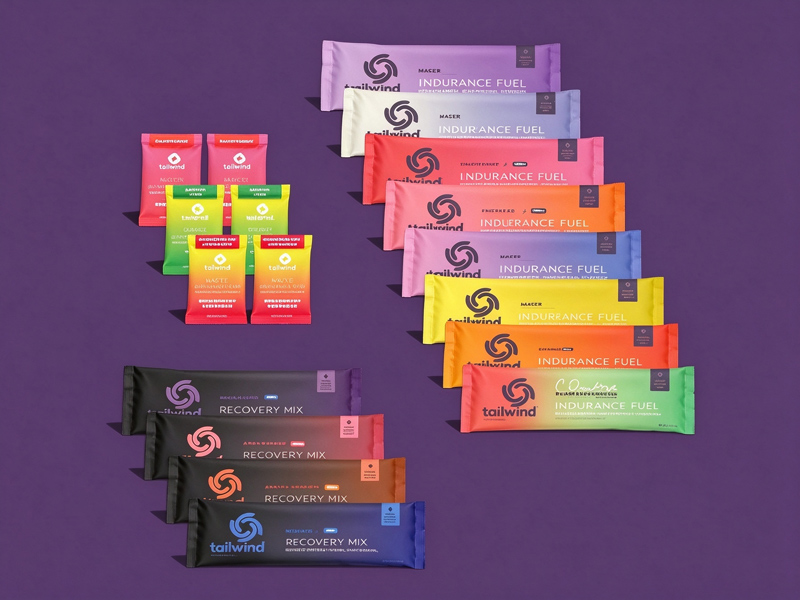
The product family grew slowly and with the same founder logic. Rebuild, the recovery mix, pairs carbohydrates with complete protein built from rice protein and amino acids plus electrolytes, targeting the short post-exercise window when glycogen replenishes fastest — developed with the company's R&D director Art, a physician and endurance athlete. Active Hydration arrived in 2022 for the other end of the spectrum: shorter sessions where full calories are unnecessary, mixing clear with grass-fed collagen and vitamin C.
This three-product architecture — fuel, recover, hydrate — covers the endurance day without sprawl. The restraint is characteristic: thirteen years in, the entire lineup still fits on one screen.
Still Mixed in Durango After Thirteen Years
Manufacturing location is a point of pride that has become a vulnerability. Every batch is mixed in Durango at the base of the San Juans, where the company started by hand-filling bags in a garage bay with a hand-crank mixer — an era that produced the famous beagle-in-the-shop quality control anecdote. The company frames local production as community investment, and the recognition backs it: Durango Chamber Entrepreneur of the Year, a Governor's Award for Excellence in Exporting, and Colorado Company to Watch honors.
The honest counterweight: heavy import dependence on ingredients like citric acid, synthetic caffeine, and cocoa has exposed the company to US tariff pressure, and the brand's UK distribution partner announced its closure in 2026 citing exactly those costs. Tariffs have no quick fix, and international availability has grown bumpier for it.
Forty Countries, Five Hundred Shops, One Warehouse
Distribution follows the product's organic growth: all 50 US states, roughly 40 countries, and more than 500 retail shops worldwide, with the Durango facility shipping everything. The Shopify store is the center of gravity — subscriptions, variety bundles, and bulk bags live online — while local run and bike shops handle the try-before-you-buy side.
Direct buyers get the full flavor range, rewards pricing, and the occasional limited-edition drop, like the anniversary flavor whose proceeds supported Bigger Than the Trail, a mental-health nonprofit that uses trail running as its platform. Community investment is a recurring theme rather than a campaign.
The Athlete Who Becomes a Believer
Tailwind's growth engine has always been the converted customer telling their training group, and the customer profile shows it: ultrarunners, 100-mile mountain bikers, and Ironman athletes who arrived after years of mid-race stomach failure. The company leans into "support crew" language — answering race-day emails personally, donating over 11,000 packets to hospitals during COVID through its Hospital Support Crew program, and pricing support during hard months.
The fit is specific. Athletes doing sessions under about 90 minutes do not need a fueling system, and sprinters will find nothing here. Tailwind is built for the person whose event lasts longer than their gut usually allows.
Fuel Decisions Worth Making Before Race Day
The verdict from thirteen years of market presence: Tailwind earned its cult following by solving one problem completely rather than many problems partially. The science-first formulation, honest origin story, and Durango-made consistency have survived industry imitation, while the tariff-era international stumbles and premium pricing versus grocery-store drink mixes remain real caveats.
For runners lining up an ultra, a trail century, or any day when nutrition has ever been the thing that broke first, Tailwind is one of the few brands whose promise matches its mechanism — and it will still be mixed in Durango when you reorder.