Epomaker review 2026: is this mechanical keyboard store worth your time and money?

Official homepage: https://epomaker.com
Custom keyboard stores usually sell you a parts list. Epomaker sells you a sound. The brand, founded in 2019 with a mission to make beautifully designed mechanical keyboards that people actually love typing on, has grown from one Kickstarter experiment into a multi-storefront operation spanning the US, Germany, Japan, and Korea. Its storefront leads with a phrase most accessory brands wouldn't dare print: "Crafted to sound right." Everything — the gasket mounts, the pre-lubed stabilizers, the layered foam — is merchandised as acoustics first and aesthetics second. I went through the store the way a curious first-time buyer would, listening before looking. Here is what each dimension revealed.
A Storefront That Treats Acoustics as the Main Product
The first thing that separates Epomaker from nearly every keyboard shop is that sound is the headline, not a spec. Product pages open with typing demos, the homepage carries a "Sound Lab" section with recordings and reviewer quotes — TechRadar, Forbes, CNN, Linus Tech Tips, RTINGS, and Tom's Hardware have all covered the boards — and the copy leans hard on phrases like "deep, creamy, satisfying typing experience." The claim is audacious, but the engineering underneath is real: gasket mounts, dual layers of EVA foam, south-facing LEDs that don't fight Cherry-profile keycaps, and stabilizers lubed before packaging. The flagship TH series is explicitly pitched as delivering a tuned "thock" out of the box, no disassembly required. For a hobby that used to demand an afternoon with a syringe of Krytox, that's a genuine repositioning.
The Prebuilt-versus-DIY Decision the Store Makes Easy
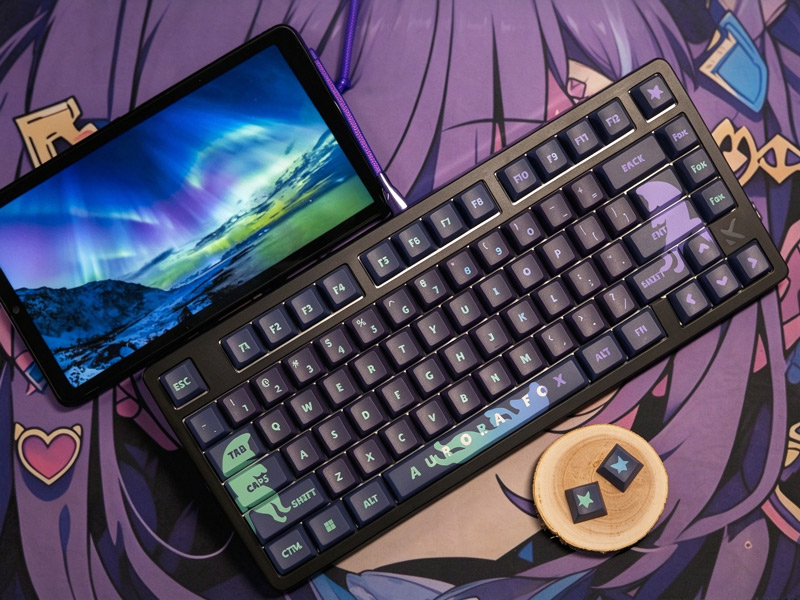
Epomaker's catalog splits cleanly into two roads, and the navigation respects the split. The prebuilt lane — TH66, TH80, EP84, NT68 — gives you hot-swap sockets, tri-mode connectivity (Bluetooth 5.0, 2.4GHz dongle, USB-C), and tuned sound for somewhere between $60 and $120. The DIY lane sells the same chassis as kits: bottom case, PCB, foam, plate, stabilizers, and battery, with switches and keycaps left to you. The TH66 kit has become something of a community standard precisely because of this modularity — a 65% layout with a programmable aluminum knob, gasket-like mounting that adds screws to cure the traditional gasket's mushy center, and compatibility with both three-pin and five-pin switches. The store even keeps split-layout oddities like the Split70 and ortholinear Hack70 in the lineup, which tells you it wants to keep experienced builders browsing too.
Software, Configurators, and the Remapping Experience
The software layer is where Epomaker quietly outclasses budget rivals. The EPOMAKER Hub runs entirely in the browser — no download, works on any device — and handles key remapping, macros, and lighting. For its QMK/VIA-compatible boards, the store publishes the JSON files you need to load the board into the VIA web app, with beginner and advanced guides that don't assume you know what a keymap is. The EP84 has been fully programmable this way since launch, and the store's documentation keeps pace with new releases better than most. The honest caveat: firmware support varies by model and revision, and the German storefront still warns buyers to check layout details — not every board in every regional shop ships with the local keycap legend. Buyer diligence is rewarded; it isn't entirely eliminated.
Four Regional Stores, One Keyboard Brand
Few accessory brands run their localization this seriously. Epomaker operates dedicated US, German, Japanese, and Korean storefronts, each with local pricing, local stock, and local return terms — the German shop, for example, offers a 15-day free return window and spells out exactly which boards carry the ISO-DE layout. This matters more than it seems: duties, shipping times, and layout mismatches are where keyboard purchases usually go wrong, and regional warehouses flatten all three. On the flip side, pricing and promotions aren't identical across the four stores, and stockouts in one region sometimes linger while another region has shelves full. The brand doesn't always tell you to check the other storefront first.
Crowdfunding Launches and the Pace of New Models
Epomaker keeps one foot permanently in the crowdfunding world. The brand has run multiple Kickstarter campaigns — the RT98 modular retro board most recently, the full-acrylic FirstBlood B67 before that — and the main storefront functions as the permanent home for what those launches prove out. Coming-soon slots like the Bamboo75, Alice40, and Galaxy75 rotate through the homepage, keeping the catalog in constant motion. The upside is relentless novelty and a store that feels alive. The downside is obsolescence anxiety: buy a TH series board and a new revision with a screen, a different knob, or Hall-effect switches lands a quarter later. The model churn rewards patient shoppers and mildly punishes early adopters.
What Your Money Buys and Where It Stops Making Sense
Value is the store's most persuasive argument. Fully built gasket-mount boards with foam, knob, and tri-mode wireless land around 60–60–120, and community consensus — echoed across YouTube and Reddit reviews — is that nothing else at the price sounds as good out of the box. Kits shave more off if you already own switches and caps. Where the math stops working is at the margins: accessories and keycap sets can be priced close to the boards themselves, and the cheapest route often involves watching a regional storefront for a sale the US site doesn't run. Warranty terms and support responsiveness are serviceable rather than standout, which is acceptable at these prices but worth knowing before checkout.