Davids' fluoride-free foundry: twelve icons of intent, metal-tube freshness, amber refills, family hands

Official homepage: https://davids-usa.com
Oral-care stores usually begin with a flavor or a claim. Davids begins with a wall of twelve promises — each rendered as a simple icon with a short caption, from EWG verified to fluoride free, from metal tube for freshness to family owned and operated. I browsed with a tube of mainstream paste nearly finished and a curiosity about what a toothpaste brand looks like when it treats the tube itself as an argument. Here is the counter, decision by decision.
Door Policy: Twelve Icons, No Paragraphs
The homepage's trust architecture is a grid of twelve square badges — every choice matters, ingredients sourced with intention, proudly made in the USA, no sodium lauryl sulfate, plant and earth based, no artificial anything, enamel health and whitening — each with a footnote where the claim narrows. Choosing icons over paragraphs compresses the entire clean-formula argument into shapes a shopper can audit in seconds, and the footnotes do the honesty work competitors skip: not every product carries the EWG seal, not every formula contains the hero ingredient. The grid is a compliance document wearing a poster's clothes.
The Fluoride Line, Drawn Publicly
Front and center sits the aisle's most divisive position — fluoride free, printed beside the alternative the store stakes its name on: nano hydroxyapatite, the mineral the body already builds teeth from. Taking a side in the fluoride debate forfeits half the aisle and claims the other half completely: the customer quietly avoiding fluoride finally finds a tube that says so without whispering, and the mineral printed next to the prohibition gives her something to cite at her next cleaning. The icon is a flag planted in a fight most brands walk around.
The Metal Tube as a Freshness Argument
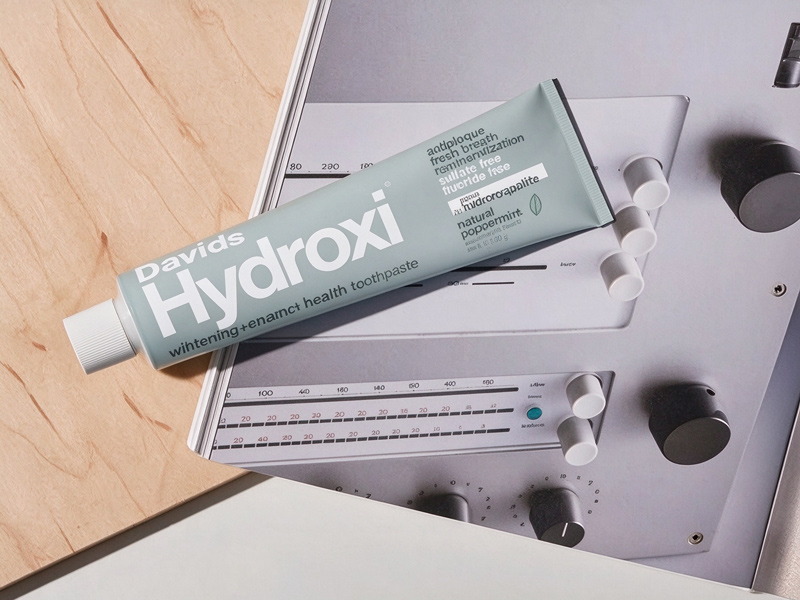
One icon reads metal tube for freshness, and the packaging follows through — paste in rolled aluminum, like the pharmacy tubes of a previous century rather than the laminated plastic of the modern shelf. Reviving metal makes a freshness claim physical: the material does not breathe the way plastic does, the last squeeze rolls tighter than the first, and the tube recycles in a way laminated tubes never could. The packaging is not a container; it is one of the twelve promises, and squeezing it is the proof.
Amber Bottles and Concentrates
The newest fixture extends the logic to mouthwash — a small brown glass bottle of concentrate, diluted drop by drop into the reusable amber vessel beside it. Selling concentrate instead of blue liquid is a shipping-weight decision disguised as design: the heavy glass vessel is bought once, the light refills forever, the bathroom shelf loses its plastic quart, and the dilution ritual buys mix-it-yourself credibility that premixed washes cannot touch. Refill, as a word, does more work here than any ingredient list.
A Family Hand on Every Tube
The most understated icon reads family owned and operated, and the store treats it as quality control rather than sentiment. Keeping ownership in the family is a consistency decision aimed at the customer burned by acquired brands that reformulated quietly: recipe decisions, sourcing calls, and the twelve-icon wall all answer to the same kitchen-table ownership, and four words on the homepage tell her so. In a category of conglomerates, the family is the differentiation.
Subscription Priced as Routine
The subscribe-and-save shelf frames the refill not as a discount mechanism but as a simplification — hassle-free delivery with subscriber perks on top. Positioning the plan as routine rather than reward targets the customer who already knows she will need another tube: the discount is secondary, the disappearance of the drugstore errand is the sale, and the subscription converts a commodity purchase into a standing relationship with the family behind the icons. Convenience, here, is the loyalty program.
Tools Without Plastic
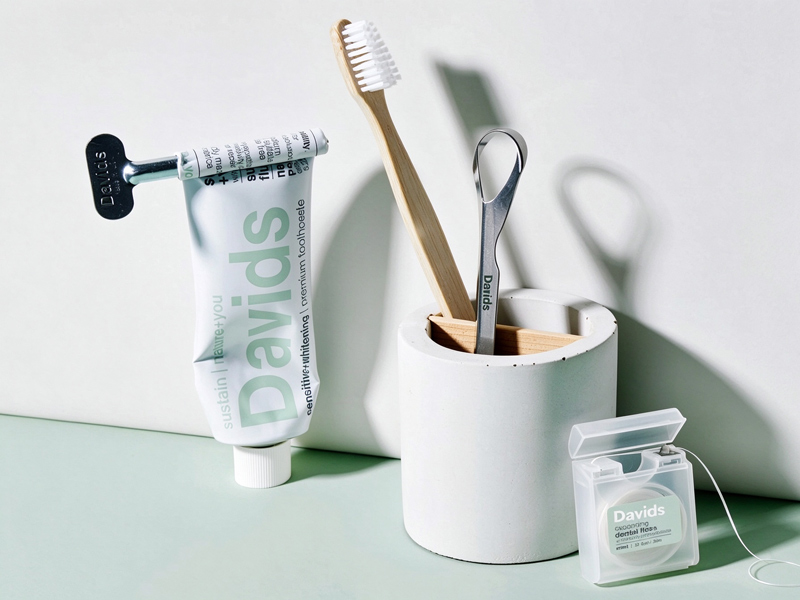
Around the paste sit the instruments — a bamboo toothbrush, a stainless tongue scraper, expanding floss threaded with the same mineral the tube champions. Extending into tools mirrors the ritual logic: the customer who commits to the mineral paste is offered the bamboo brush to apply it with and the scraper to finish the job, each echoing the twelve icons in material, each turning a single-tube order into a bathroom-system order. The tools complete the sentence the tube began.