
Shopify vs Amazon: e-commerce platform comparison 2026
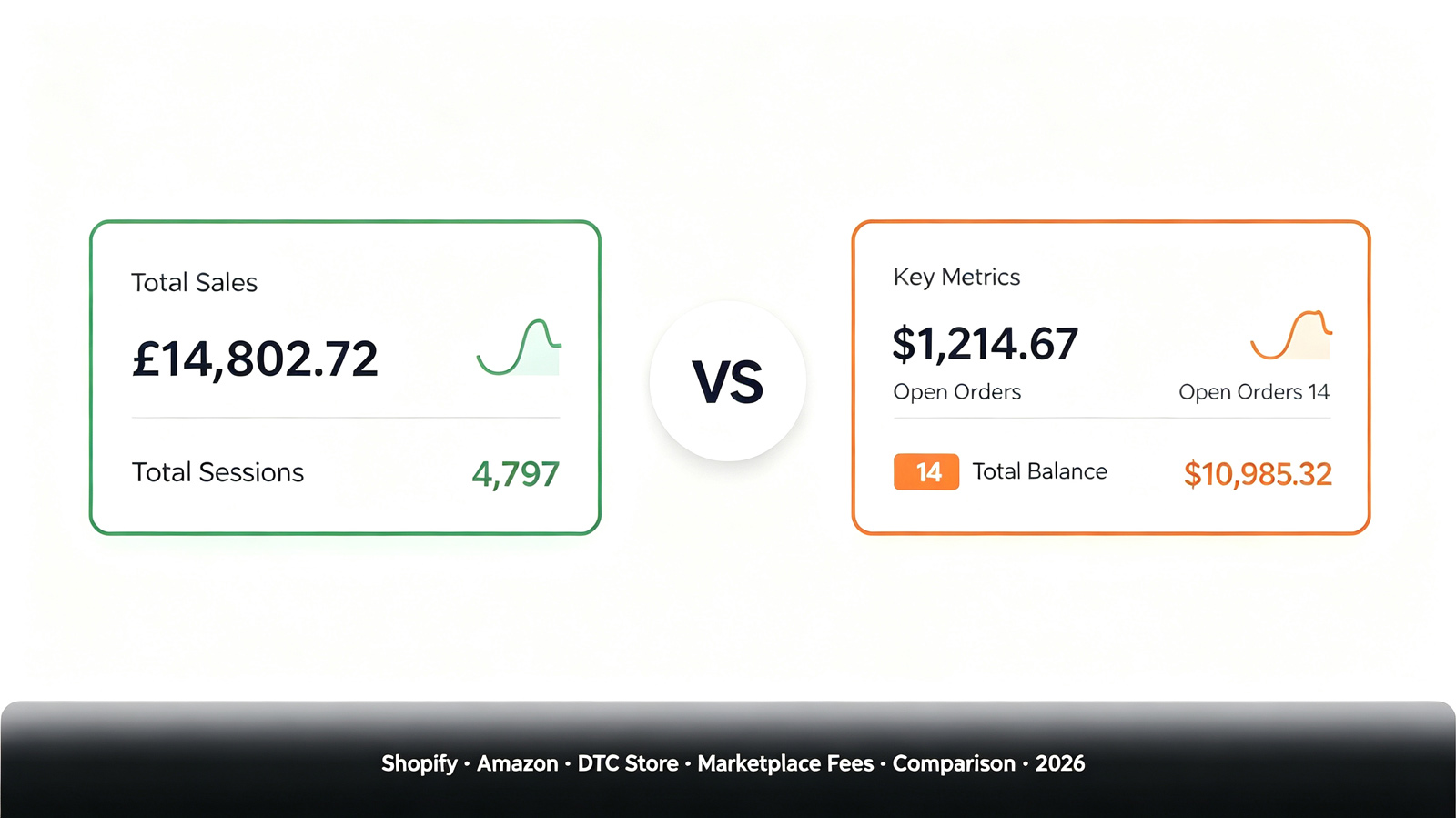
This guide compares Shopify and Amazon as sales channels for e-commerce businesses. It covers cost structures, traffic models, data ownership, and operational requirements to help sellers choose a starting point or expansion strategy.
Platform Overview
Shopify is a hosted e-commerce platform that allows merchants to build independent online stores. Sellers control their domain, store design, pricing, and customer data. Traffic generation is entirely the seller's responsibility.
Amazon is a third-party marketplace. Sellers list products within Amazon's catalog and gain access to the platform's existing customer base. Amazon controls the storefront environment, search algorithm, and customer communication policies.
Cost Structure
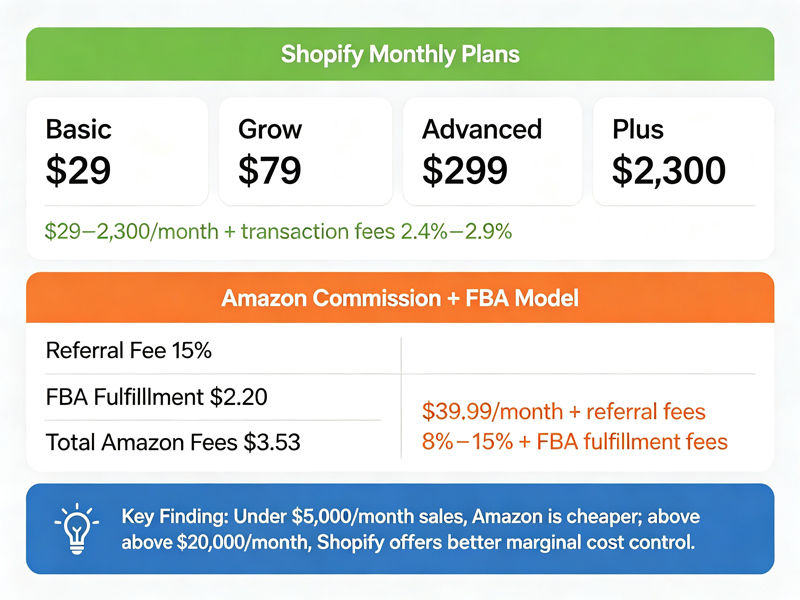
Shopify operates on a subscription model. Merchants pay a fixed monthly fee based on plan tier, plus payment processing fees per transaction. There is no percentage-based commission on sales.
Amazon operates on a variable-cost model. Sellers pay a monthly subscription, a percentage-based referral fee on every sale, and optional fulfillment fees if using FBA. Additional costs include storage fees, advertising, and potential long-term storage penalties.
Official Shopify pricing: https://www.shopify.com/pricing
Amazon seller fee breakdown: https://sell.amazon.com/pricing
Cost Comparison at $10,000 Monthly Revenue
The following breakdown illustrates estimated monthly costs for a seller processing approximately $10,000 in gross sales.
Shopify:
- Platform fee (Grow plan): $79
- Payment processing (2.7% + $0.30 per transaction): ~$270
- Email marketing app (Klaviyo, mid-tier): ~$120
- Paid traffic (Meta Ads, estimated): ~$400
- Total estimated cost: ~$869
- Estimated net retention: ~$9,131
Amazon:
- Seller subscription: $39.99
- Referral fees (average 15%): ~$1,500
- FBA fulfillment and storage: ~$780
- Sponsored Products advertising: ~$640
- Total estimated cost: ~$2,960
- Estimated net retention: ~$7,040
Cost behavior by volume:
- Below $5,000 monthly revenue, Amazon often incurs lower total costs due to minimal advertising spend and the absence of fixed platform fees at scale.
- Above $20,000 monthly revenue, Shopify's fixed-cost model typically yields better margins, as payment processing fees decrease as a percentage of revenue and there is no per-sale commission.
Traffic and Customer Acquisition
Shopify: Merchants are responsible for 100% of traffic generation. Common channels include paid social advertising, search engine optimization, influencer partnerships, and email marketing. There is no built-in audience.
Amazon: Products are listed within an existing marketplace with built-in search traffic. Visibility depends on organic search ranking, which is influenced by sales velocity, reviews, pricing, and fulfillment method. Most active sellers supplement organic reach with Amazon PPC advertising.
Data Ownership and Customer Relationships
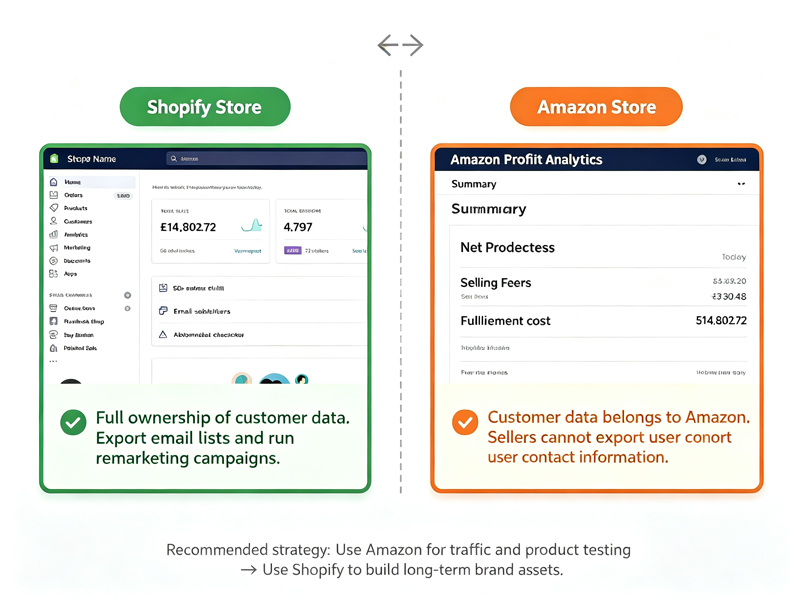
Shopify: The merchant owns all customer data, including email addresses, purchase history, and browsing behavior. This data can be exported and used for email marketing, retargeting, and loyalty programs.
Amazon: Customer data belongs to Amazon. Sellers cannot export buyer email addresses or contact customers outside of Amazon's messaging system. Repeat marketing to past buyers is not permitted.
Brand Control and Store Environment
Shopify: Full control over storefront design, product page layout, checkout flow, and domain branding. No direct competitors appear on the same product page.
Amazon: Limited control over product page layout. Listings follow Amazon's standardized format. Competing offers frequently appear on the same product page via the "Buy Box" and "Other Sellers" sections. Branding elements are restricted to A+ Content and store pages.
Risk Factors
Shopify: Primary risks include advertising cost volatility, technical maintenance, and the learning curve associated with driving independent traffic. There is no platform-level risk of account suspension removing access to the customer base.
Amazon: Primary risks include account suspension due to policy violations, IP complaints, or algorithm changes. A suspended listing or account can result in immediate revenue loss. Sellers also face direct price competition from other merchants on identical product pages.
Hybrid Strategy: Using Both Platforms
Many mid-to-large scale sellers operate on both platforms simultaneously. A common operational model includes:
- Product validation on Amazon: New SKUs are listed to gauge demand using existing marketplace traffic.
- Brand building on Shopify: Proven products receive dedicated product pages, content marketing, and bundle offers.
- Inventory synchronization: Tools such as Shopify Marketplace Connect or third-party ERPs sync stock levels across channels to prevent overselling.
Platform Selection Guide
Choose Amazon if:
- The product is generic or commoditized.
- Fast revenue validation is the priority.
- Advertising budget is limited for external traffic generation.
- The seller prefers Amazon to handle fulfillment and logistics.
Choose Shopify if:
- The product is unique or proprietary.
- Long-term brand equity is a priority.
- Customer data ownership is required for marketing.
- Average order value exceeds $50, making fixed-cost economics favorable.
Operate both if:
- Sales are consistent on one channel.
- Inventory management systems can handle multi-channel stock tracking.
- The business has resources to manage separate operational workflows.
Summary
Amazon provides built-in traffic and operational convenience at the cost of margin and data ownership. Shopify provides margin control and data ownership at the cost of traffic generation responsibility. The optimal choice depends on product type, capital availability, and long-term business objectives.