Plunging at aeropress: french-press rivalry tables, walnut premiums, tattooed fandoms, world championships today

Official homepage: https://aeropress.com
Cooking-appliance stores usually sell you the machine and send you to a blog for the knowledge. AeroPress sells you a forty-dollar plastic tube with the confidence of a museum — and the storefront opens, tellingly, with a comparison table against its oldest enemy. I browsed with a French press gathering dust and a curiosity about what a store looks like when the product has become a sport. Here is the counter, decision by decision.
Door Policy: Pick the Fight Before the Product
The homepage's first act is not a hero product but a scorecard — ten features in two columns, the AeroPress side full of checkmarks, the French press side conspicuously empty: no grit or bitterness, ready in one minute, cleans in seconds, shatterproof, works with every grind size. Opening with the rival rather than the self makes the category decision physical — the store does not describe what it is, it demonstrates what the incumbent lacks, and a visitor loyal to the French press leaves knowing exactly why she should not be. Naming the enemy is cheaper than naming yourself.
A Patent Compressed Into Three Hexagons
The technology story arrives as a triptych of hexagons — fast immersion, air pressure, micro-filtration — three mechanisms credited for the smooth, full-bodied cup the scorecard promised. Compressing the physics into three icons serves the customer who will never read a patent: she can repeat the triptych at a dinner party, and the hexagon motif repeats across the site, the packaging, and the accessories until the shape itself becomes the signature. The icon system is engineering made portable.
One Silhouette, Five Materials
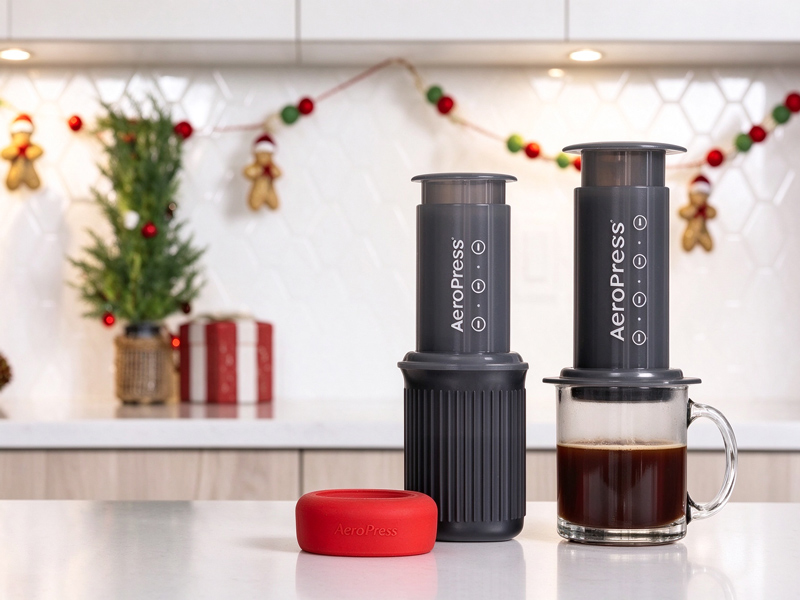
The catalog sells the same brewing shape in a full material gradient — original shatterproof plastic, a clear Tritan version in six colors, the travel Go with its nesting cup, an XL for company, and a premium edition of double-walled glass, steel, aluminum, and walnut. Selling one mechanism in escalating materials segments by budget without asking anyone to relearn the brew: the beginner buys plastic, the enthusiast upgrades to walnut, and every filter, stirrer, and carafe fits every generation. The silhouette is constant; the revenue ladder is the variable.
Devotion Curated on the Front Page
Scrolling the homepage, I found not products but proof of belonging — a tattooed forearm carrying a percolator in ink, an oil portrait of a woman drinking before a Frida Kahlo backdrop, a T-shirt graphic of flowers blooming from the chamber, a cartoon-blue press with googly eyes. Publishing fan art on the storefront converts customers into collaborators: a device boring enough to tattoo has crossed from appliance to identity, and the gallery tells every new visitor that the thing she is about to buy already belongs to a culture. The gallery is the cheapest loyalty program in the building.
Consumables and Spare Parts as the Engine
The all-products page reveals the architecture — the brewers number perhaps half a dozen, but filters, replacement seals, filter caps, steel organizers, and spares run into the dozens, organized by generation: original parts, Clear parts, Go parts, XL parts. Designing the device around two-dollar seals and filter subscriptions reverses planned obsolescence — the brewer from a decade ago is still fully serviceable, the second purchase feels like maintenance rather than replacement, and the consumable is the recurring revenue that the appliance's modest sticker never was.
The Grinder Designed to Disappear
The newest accessory argues in a single photograph — a hand grinder whose crank folds flat and whose body slides inside the brewer, handle and all, titanium-coated burrs and a wooden base included. Designing an accessory to vanish into its host product serves the traveler directly: grinder, press, filters, and cup pack into the volume of a water bottle, and the nested photo outsells any spec sheet. The accessory does not compete with the brewer for bag space; it borrows it.
Closing the Loop With Beans
At the bottom of the storefront sits an aisle that breaks the appliance-store frame — more than two hundred coffee roasts, custom-ground to the medium-fine the brewer prefers. Extending from hardware into beans closes the loop the device opened: the brewer recommends the grind, the grind recommends the beans, and the customer who trusted a forty-dollar tube eventually trusts the store with her recurring coffee order, which is where the lifetime value lives. The appliance is the doorway; the beans are the house.