Meater, hands-on: the wireless thermometer store behind perfect roasts and frustrating disconnects
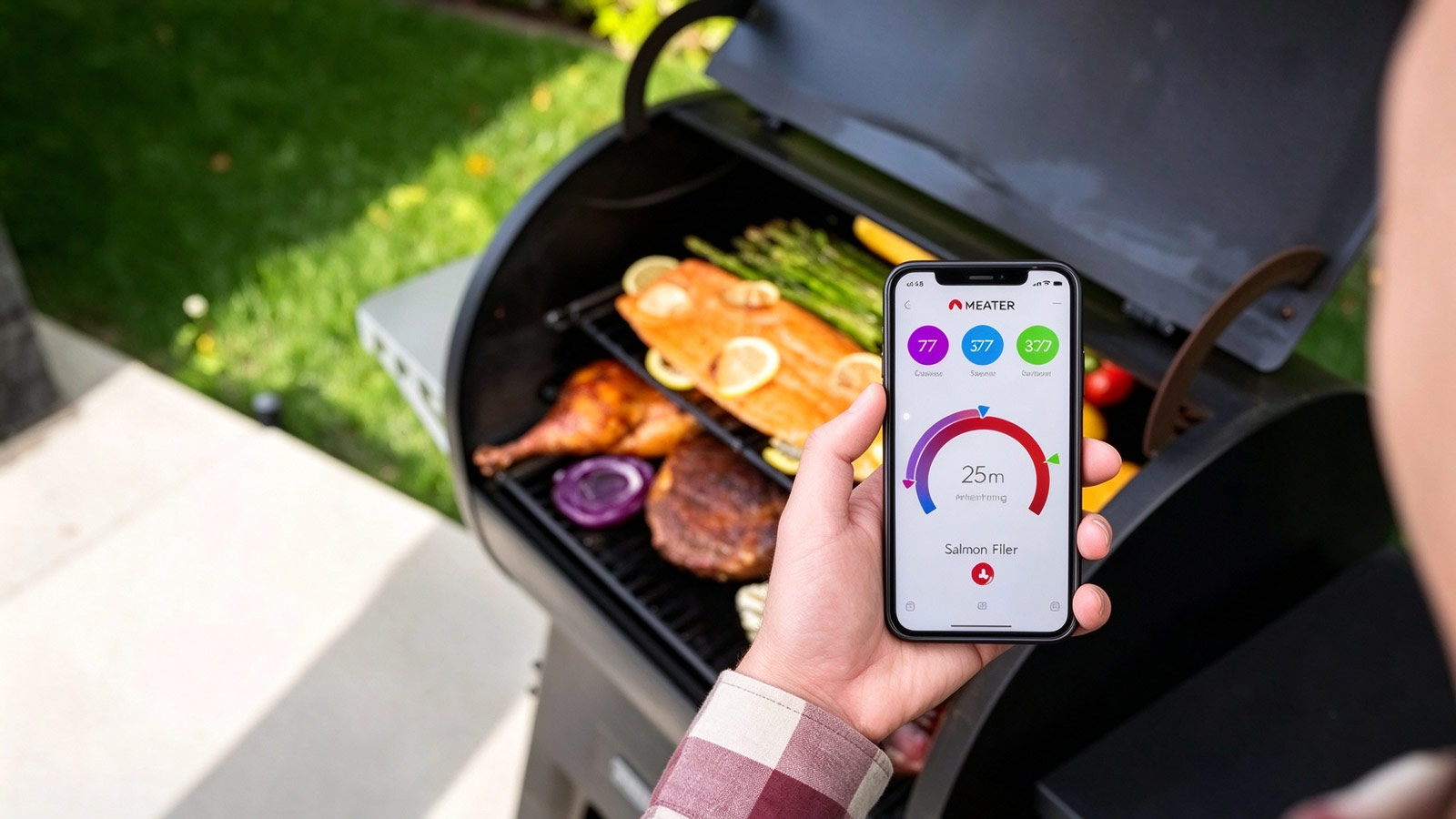
Official homepage: https://meater.com
Cooking stores usually sell you an appliance. Meater sells you a feeling — the confidence to walk away from the grill. Founded in 2015 by three engineers under the Apption Labs banner, the company made a single bet: that the meat thermometer's wire, the thing that tangles, frays, burns, and blocks rotisserie baskets, was the enemy. The result was the first truly wireless probe — one stick carrying two sensors, no cable, no transmitter box — and it became a phenomenon the company measures in cooks rather than units: more than five million users and eighty million completed cooks by 2026. Traeger Grills acquired the brand in 2021, folding it into the pellet-grill empire while leaving the product line to compete on every kind of cooker. I went through the probes, the physics, and the complaint threads. Here is the store across its dimensions.
The First Truly Wireless Probe
The origin story is the product. Before Meater, "wireless" thermometers meant a wire running from your meat to a transmitter somewhere outside the grill; every competitor still works that way. Meater's probe contains its own battery, Bluetooth radio, and two sensors — one for the meat's interior, one for the ambient heat around it — sealed in stainless steel and ceramic, dishwasher safe, and slim enough to leave in a steak. The company claims that wirelessness is not a convenience but a capability: it is the only leave-in thermometer that works on a rotisserie, where any wire would wrap and tear. That single use case, repeated across grilling forums for a decade, built the brand.
The Probe Lineup
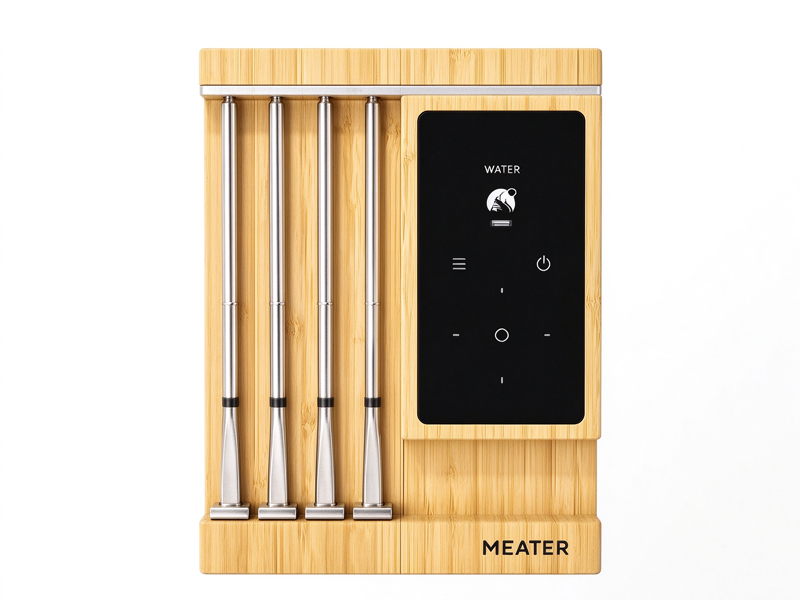
The current wall runs five deep. The MEATER Plus at $99.95 is the bestseller: the probe plus a wooden charger that doubles as a Bluetooth repeater, stretching range to a claimed 165 feet and topping the probe up for a hundred cooks from one AAA battery. The MEATER 2 Plus upgrades accuracy with five internal sensors and one ambient, rated to a thousand degrees ambient with a zirconia ceramic band and fast charging — five minutes on the dock buys a two-hour cook. The MEATER Block at $299.95 holds four probes and adds WiFi and a built-in display for cooks without a phone nearby. The MEATER Pro Duo pairs two fifth-generation probes with a WiFi charger for around $199. And the MEATER SE, launched in 2025 at $49.99, strips the spec sheet to one sensor to hit a giftable price. Every tier shares the same free app and cloud.
The App Is the Product
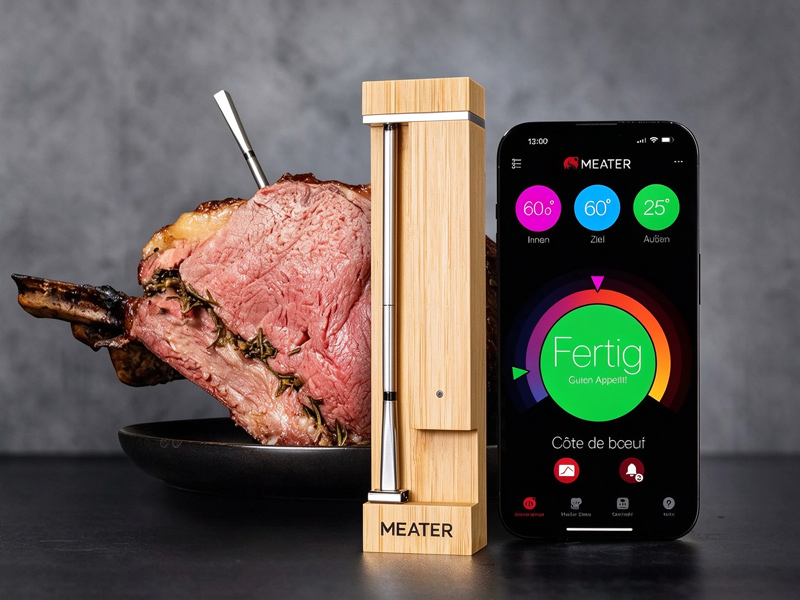
The software deserves its own paragraph because it is the moat. The Guided Cook System walks a first-timer through protein, cut, and doneness; the Advanced Estimator Algorithm projects not just when the meat hits temperature but when to start the sides, counting down cook and rest together. MEATER Link lets a spare phone or the Block bridge the probe onto your home WiFi for monitoring from the grocery store, and MEATER Cloud keeps that service free — no subscription, a genuine rarity in connected kitchen gear. An Alexa skill answers "how's my meat," cook graphs satisfy the data-curious, and MEATER Master Class layers recipe videos on top. The app is consistently rated the best in the thermometer category, and reviewers who hate the hardware rarely fault the software.
The Physics of Metal Grills
The honest physics, because this is where expectations go to die. A probe inside a closed metal grill sits in a Faraday cage; every wireless thermometer struggles there, and Meater's Bluetooth signal is no exception — professional reviewers describe connection drops as "widespread and well known," with the fix being Block placement close to the smoker door and the understanding that walls, not the probe, are the problem. Two usage traps complete the physics lesson: the probe must be inserted past its safety notch or its 212-degree internal sensor can be damaged by a screaming-hot sear, and the ambient sensor at the handle end reads cooler than the grate at the start of a cook — the community's fix is the sacrificial potato, skewered first to preheat the probe's environment.
The Storefront
The direct store runs on regional Shopify storefronts, led by the U.S. shop, and merchandises like a company that understands gifting: bundles pairing probes with Mitts and boards, a two-year warranty badge on product pages, free shipping thresholds, and colorway drops. The Pro Duo has spent stretches sold out direct while Amazon, Costco, and the big-box channels carry the volume — the classic DTC-versus-retail seesaw of a Traeger-owned brand.
The Quality-and-Service Ledger
Here is the ledger the marketing does not show. Trustpilot reviews over the past year describe chargers whose battery contacts fell out, probes that lose pairing after a handful of cooks, and connection drops that customer service logs insist did not happen — while a technician, one reviewer alleges, quoted the user's own cook data back without being asked. The service experience behind those failures is the store's deepest wound: ninety-minute phone queues, email addresses that bounce, refund runarounds with thirty-day windows weaponized, replacement probes shipped in the wrong model, and goodwill offers of 15 percent off a new unit instead of fixing the old one. Against that, the same pages hold genuinely fast turnarounds — a replacement probe inside three days — and named support agents praised by name. The pattern is inconsistency at scale, not indifference.
Where It Fits
Against the field, Meater owns the wire-free niche outright — ThermoWorks' wired Signals will out-accuracy it, and Traeger's own probes integrate deeper with its grills, but nothing else rotisseries. The Block's $299.95 price buys convenience a phone-plus-Link setup delivers for $99.95, and ambient-sensor accuracy at cook start trails the wired pros. The SE at $49.99 is the category's best gift entry, which is exactly where the funnel wants new users.
One Last Temperature Check
Meater is the rare single-product store that turned a deleted wire into a decade-long category: the best app in the business, a free cloud, a probe that does something no competitor can, and a storefront that understands gifting. What you accept is the physics of metal grills, a quality record that runs hot and cold, and a service operation that — on its bad days, which are frequent enough to document — makes a $100 stick feel like a subscription to frustration. Buy the Plus, learn the potato trick, keep the receipt, and check the charger contacts the day it arrives.