Lightening the sit at helinox: dac-pole bloodlines, chair-one genesis, re-tension revisions, beach seasons

Official homepage: https://helinox.com
Camping stores usually treat furniture as an afterthought — a camp chair is where a brand dumps its leftover canvas. Helinox treats the chair as the whole argument. The storefront opens with a furniture maker's oath, not an outfitter's: we design the world's lightest, strongest, and most comfortable camp furniture, full stop. I browsed with a bad back, a heavy pack, and a decade of watching collapsible chairs die mid-season. Here is the counter, decision by decision.
Door Policy: Furniture as Headline, Not Accessory
Most outdoor stores lead with a tent or a pack and let chairs ride in the accessories tab; this store leads with the chair and puts its engineering oath in superlatives — lightest, strongest, most comfortable. Taking furniture out of the accessory tab re-prices the entire store: the customer is not buying camping gear with a seat attached, she is buying furniture that happens to pack into a tube, and that reframing defends margins no canvas chair could support. The oath doubles as a filter — anyone who does not need a chair at a gram's notice was never the audience.
Bloodlines From the Pole Business
Helinox grew out of DAC, the aluminum pole maker whose tent poles have held up half the lightweight shelters in the industry for decades — which means the chair is, structurally, a set of tent poles wearing a sling. Printing that lineage on the brand turns heritage into material proof: the frame is the product, the fabric is the accessory, and every gram saved is a pole manufacturer's core competency arriving in a new category. The brand did not learn lightweight engineering; it exported it.

A Spectrum Sold as a Family
The bestseller shelf reads like a design thesis: Chair One, the chair that started it all; Chair Zero LT, the lightest yet, for those who count grams; the Sunset Chair (re), reissued under a new tension design claiming a fresh comfort standard; the Savanna, the largest in the house, for those who decided grams were negotiable. Selling comfort as a spectrum instead of a single hero lets each buyer locate her own trade-off between pack weight and back happiness, and returns drop when customers choose their own compromise rather than accepting the brand's.
(re) as a Public Revision Ledger
The Sunset arrives wearing a parenthetical — (re) — a small mark that admits the chair has been revised and invites the returning customer to ask what changed. Putting the revision in the product name borrows software release notes for physical goods: last year's buyer learns her model remains valid, this year's buyer learns the design is alive, and engineering gains a public ledger of improvements. The parenthetical turns a product update into a promise of continued attention.
A Beach Season Doubling the Calendar
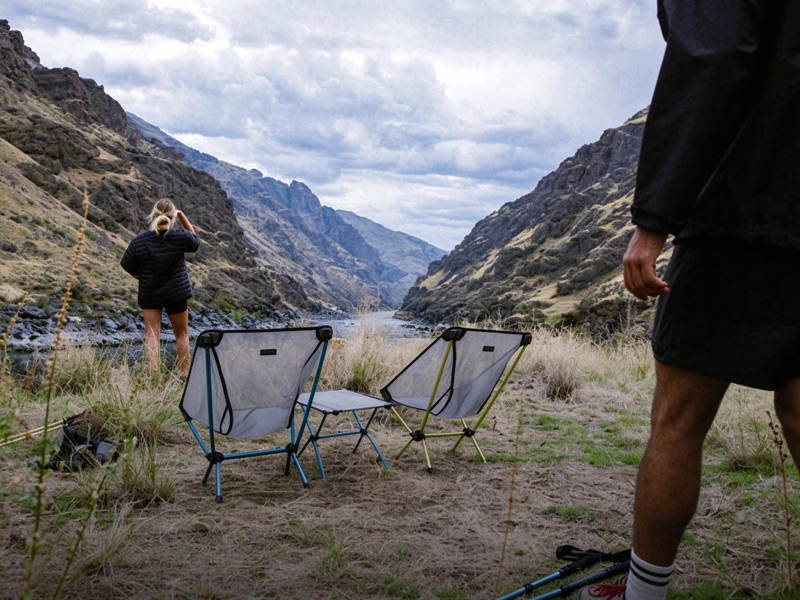
When I visited, the front of the store had been given over to the Beach Collection — shore colors, sand-friendly fabrics, the same poles re-dressed for summer. Building a seasonal beach line doubles the selling season without doubling the factory: the spring trail-chair buyer has a reason to return in July, and the floor plans, molds, and warranty infrastructure carry straight across. The collection is the same argument wearing sunglasses.
Pack It, Go, Repeat
Under every product runs the same three-word instruction — pack it, go — and the engineering obeys: chairs collapse into stuff sacks small enough to vanish into a daypack, assemble in one motion, and carry a five-year warranty against the failure that kills cheaper chairs. Engineering for the thousandth setup rather than the showroom photo is a word-of-mouth bet, because a camp chair fails — or survives — in front of exactly the audience a brand wants to impress.
Accessories as the Second Basket
Around the chairs orbits a constellation of small objects — cup holders, ground sheets, side tables, spare feet — each priced low enough to ride along with a chair order. The accessory shelf dresses margin as completeness: the chair closes the sale, the cup holder fills the box, and a customer who once ordered a single chair returns for the ecosystem that makes the chair hers. The small parts finance the brand between big purchases.