GRAYL store review: what to know before you buy water purifier bottles in 2026

Official homepage: https://grayl.com
Camping stores usually sell shelter, sleep, and fire. The fourth necessity — water — usually arrives as an afterthought in the accessories tab. GRAYL builds its entire store around that fourth thing: the homepage promises clean water anywhere on earth, and every product beneath the promise is a variation on a single gesture — fill, press, drink. I browsed with a memory of boiling stream water on a trip that gave me nothing but time, and a curiosity about the eight seconds the brand keeps mentioning. Here is the counter, decision by decision.
Door Policy: The Planet as the Territory
The storefront's promise is geographic before it is technical — clean water anywhere on earth — five words that enlarge the category from camping to every context where a tap cannot be trusted. Framing the product by territory rather than by feature widens the market to the traveler who will never backpack but will absolutely visit a country where the guidebook says do not drink the tap: the planet is the addressable market, the bottle is the visa, and the store has sold the same object to the hiker and the tourist with one sentence. The earth is the shelf; the shelf has no borders; and the borders are exactly what the bottle erases.
Three Verbs as the Entire Manual
The product's operation is compressed into a trademarked trilogy — fill, press, drink — three words that replace the manuals of pump filters and chemical tablets. Compressing the instructions to three verbs is usability positioning aimed at the customer who has abandoned a pump filter in a river: the verbs say the mechanism is one motion, the eight seconds say the motion is fast, and the store has converted the most anxious moment of backcountry travel — drinking — into something the bottle does for you. The verbs are the manual; the manual is eight seconds long; and the eight seconds are the shortest manual in the outdoors.

The Cartridge as a Countdown
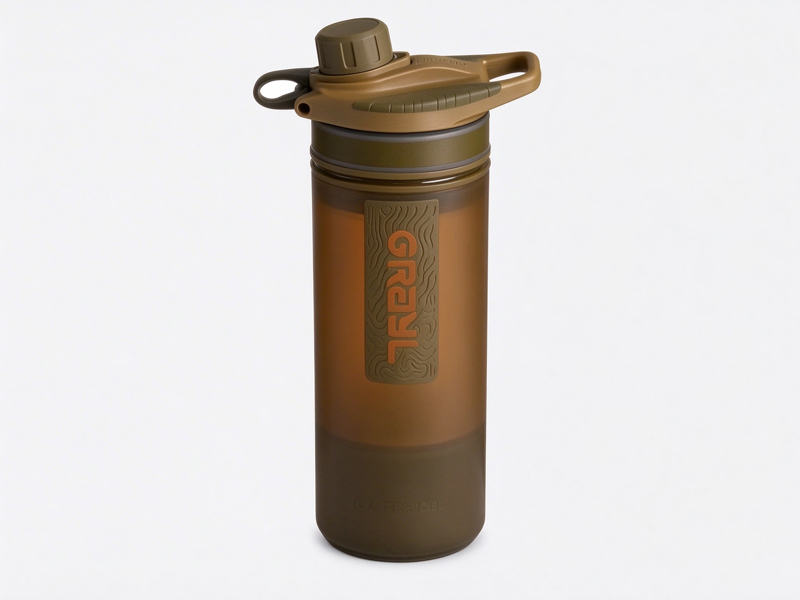
Beneath the bottle sits the consumable — a purifier cartridge rated for three hundred fifty presses, the lifespan printed in gestures rather than months, a countdown the customer can feel in her own hands. Rating the filter in presses is transparency aimed at the buyer who suspects consumables of being profit engines: the number is testable — when the press slows, the cartridge is dying — and the store has given the customer a gauge she can read with her palms. The presses are the fuel gauge; the gauge is honest; and the honesty is what sells the second cartridge, because the second cartridge is bought by a customer who trusted the first.
Titanium Does Three Jobs
At the top of the line sits a vessel that triples — a titanium GeoPress that purifies, filters, and cooks, the outer cup rated for open flame and pocket stoves, the press mechanism nested inside. Making the bottle a cookpot is consolidation aimed at the gram-counter whose pack inventory is a zero-sum game: the purifier replaces the pot, the pot replaces the second bottle, and the store has merged three line items into one purchase. The titanium is the argument; the argument weighs less than the three things it replaces; and the weight saved is the reason the gram-counter forgives the price.
Ten Years, Printed on the Housing
The warranty runs a decade — the bottle rated to survive ten-foot drops onto concrete, the guarantee printed beside the price rather than buried in the footer. Printing the ten-year term is a durability bet aimed at the customer who has snapped a cheaper filter on a rock: the decade says the company expects the bottle to outlast the trips, the drop rating says the expectation has been tested, and the store has converted a specification into a promise. The decade is the promise; the concrete is the test; and the test was passed, repeatedly, on purpose, so that the customer would never have to run it herself.
The Cartridge Comes Back
The consumable has an afterlife — a zero-waste cartridge recycling program, the used filters returned rather than binned, the program printed where the replacements are sold. Running a take-back on a consumable is a lifecycle decision aimed at the environmentally accounted buyer: the program says the company owns the waste it creates, the recycling closes the loop the cartridge opened, and the store has made the disposable part of its business feel less disposable. The return is the loop; the loop is the brand's conscience, made operational; and the operational conscience is the reason the environmentalist buys the second cartridge too.
One Percent for the Watershed
The footer carries the membership — one percent of every sale to environmental protection, the alliance's logo printed beside the warranty. Publishing the pledge is values positioning aimed at the customer who buys outdoor gear to be in nature: the percentage says the brand funds the places the product is used, the alliance's name says the money is audited, and the store has aligned its commerce with its customer's reason for existing. The watershed is the beneficiary; the beneficiary is the customer's happy place; and the customer is happy to pay for the plumbing that keeps the happy place drinkable.
Out of Stock, Announced Like News
When I browsed, the titanium model wore a banner the brand treats as content — back in stock, printed like a headline, the return of the inventory announced the way other stores announce launches. Treating restock as news is scarcity operations aimed at the waitlisted: the banner says demand outruns supply, the return is an event the customer should act on, and the store has converted a logistics update into a conversion moment. The restock is the headline; the headline is the urgency; and the urgency is manufactured by the customers who bought the last batch, which is the only kind of urgency that cannot be faked.